


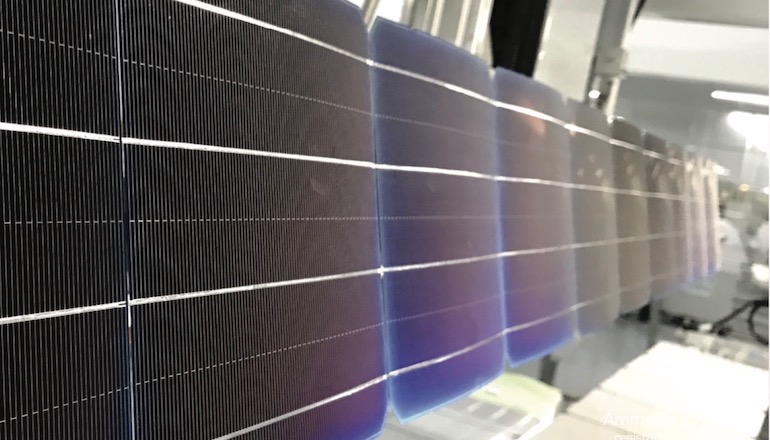
Researchers at the US National Renewable Energy Laboratory (NREL) have conducted the first global assessment into approaches to end-of-life management for photovoltaic modules.
PV modules have a 30-year lifespan and the volume of modules that reach the end of their operational lifetime could total 80 million metric tonnes by 2050.
NREL’s study considers the challenge posed by the nature of the waste from old PV modules, which are made of valuable, precious, critical, and toxic materials.
While numerous articles reviewing individual options for PV recycling have been published, NREL’s study provides a global assessment of all PV recycling efforts to identify the most promising approaches.
NREL senior scientist Garvin Heath said: “PV is a major part of the energy transition.
“We must be good stewards of these materials and develop a circular economy for PV modules.”
Heath is lead author of “Research and development priorities for silicon photovoltaic module recycling supporting a circular economy”.
Heath and his co-authors from NREL, including Timothy Silverman, also collaborated with outside experts, particularly in solar manufacturing.
“It provides a succinct, in-depth synthesis of where we should and should not steer our focus as researchers, investors, and policymakers,” Heath said.
The authors focused on the recycling of crystalline silicon, a material used in more than 90% of installed PV systems in a very pure form.
It accounts for about half of the energy, carbon footprint, and cost to produce PV modules, but only a small portion of their mass. Silicon’s value is determined by its purity.
“It takes a lot of investment to make silicon pure,” said Silverman.
“For a PV module, you take these silicon cells, seal them up in a weatherproof package where they’re touching other materials, and wait 20 to 30 years-all the while, PV technology is improving. How can we get back that energy and material investment in the best way for the environment?”
The authors found some countries have PV recycling regulations in place, while others are just beginning to consider solutions.
Currently, only one crystalline silicon PV-dedicated recycling facility exists in the world due to the limited amount of waste being produced today.
Based on their findings, the authors recommend research and development to reduce recycling costs and environmental impacts, while maximising material recovery.
They also emphasise that the environmental and economic impacts of recycling practices should be explored using techno-economic analyses and life-cycle assessments.
Finally, the study said finding ways to make solar panels last longer, use materials more effectively, and produce electricity more efficiently, is also important to reduce waste.