


The Offshore TSO Collaboration, made up of European TSOs, has presented an updated concept for a cross-border offshore energy system that brings regional planning, cost allocation and financing into a single framework.
Up to 1000TWh of clean electricity could be generated and transported in northern waters by 2050, corresponding to around 40% of Europe’s power demand by mid-century, according to the initiative.
The recommendations were unveiled at the North Sea summit in Hamburg, where work by participating transmission system operators underpinned the proposals.
CEOs from TenneT Holding, the Elia Group, Energinet, TenneT Germany, EirGrid, Statnett, NESO, Amprion, National Grid Ventures and RTE France outlined the measures and next steps at a press conference.
The OTC added that it is ready to work with governments, regulators and energy producers on the path toward a sustainable, secure and interconnected offshore future.
“Europe’s energy future will not be created solely through national individual solutions, but through regional planning, fair cost sharing and flexible financing,” stated the initiative.
The collaboration said its work shows how technical expertise and political will can combine to realise a connected offshore energy system in the North Sea.
A central focus is the development of an integrated European offshore grid built around hybrid links rather than isolated national connections.
Initial joint analyses indicate lower costs, higher efficiency and a more robust European energy system under a regional approach, the group added.
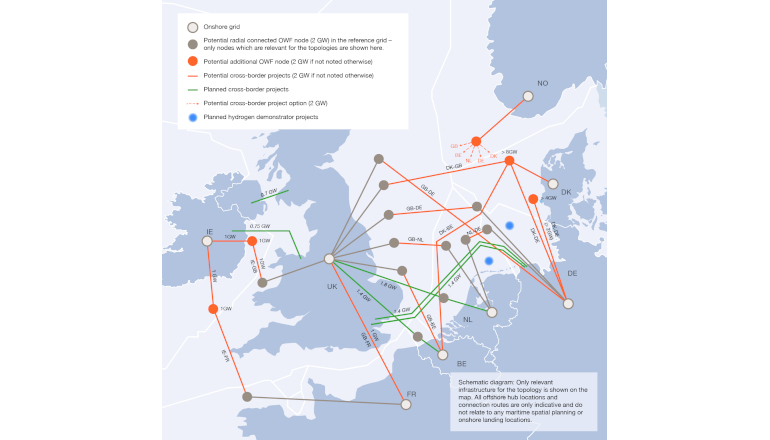
An OTC-developed network map already highlights concrete cross-border projects in the North Sea, the Irish Sea and the Celtic Sea.
The collaboration is also addressing challenges stemming from differing ownership structures, regulatory regimes and revenue models among North Sea TSOs.
The OTC said these differences show that a single financing solution is not feasible, making cost allocation and participation key issues.
Models for multilateral cooperation and shared cost distribution are being developed to enable investment decisions and unlock implementation.
Public loans, private finance, green bonds, guarantees, hybrid instruments or grants could all form part of the financing mix, the group added.
The OTC said long-term and reliable regulatory frameworks for cost sharing are essential to mobilise large-scale capital.
Work is also expanding to include wind farm developers, infrastructure operators and the hydrogen sector.
A combined ex-ante and ex-post method is proposed to resolve long-standing cost-sharing barriers for cross-border projects.
Ex-ante allocation would set national cost shares before construction based on jointly modelled scenarios, while ex-post adjustments after commissioning would reflect the real benefits observed in each country.
The OTC said this system gives the certainty required for major infrastructure investment while retaining flexibility.
Financing tools should reduce capital costs, use existing processes and funds, share risks appropriately, account for regulatory and ownership differences and support private capital, the group added.
The political impetus for the collaboration originated at the 2022 Esbjerg summit, where governments set out a shared North Sea offshore vision.
The TSOs of the region then formed the OTC to convert political ambition into practical technical solutions.
Since then, the group said it has become a key partner providing analyses, regional planning proposals and workable concepts to support Europe’s offshore build-out.
Its work aims to translate European energy policy goals into realisable projects forming the basis for offshore expansion.
The OTC was founded in 2022 and brings together TSOs from the northern seas to develop sustainable offshore grid infrastructure.
Its members are 50Hertz, Amprion, Creos, the EirGrid Group, Elia, Energinet, NESO, National Grid, RTE, Statnett, TenneT Holding and TenneT Germany.