


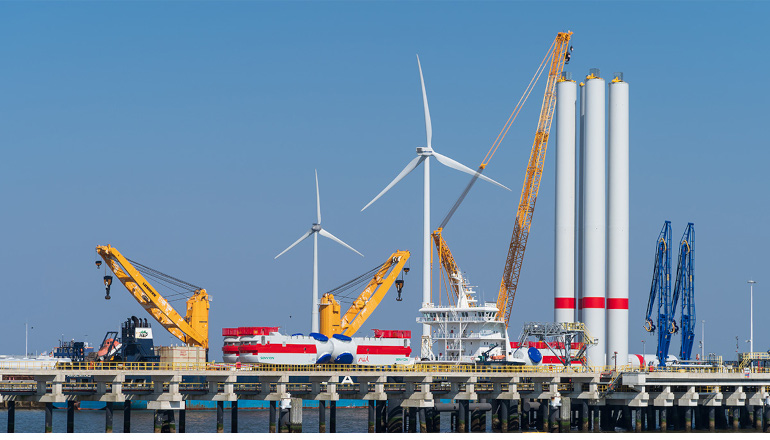
Europe must invest an additional €6bn-plus in ports and vessels if it is to meet its offshore wind targets for 2030 and beyond, according to WindEurope.
The trade body said the EU plans to grow offshore wind capacity from 36.6GW today to 84GW by the end of the decade, requiring at least 10GW of annual installation and maintenance. After 2030, deployment will have to rise to 15GW a year.
WindEurope warned that while Europe currently has the capability to install and service about 10GW annually, maintaining and expanding this level will require significant upgrades to maritime infrastructure.
The organisation reported that €6.7bn has been invested over the past three years in port facilities and vessels for offshore wind, including €4.4bn in ports and €2.3bn in new ships. However, it said a further €6.4bn is needed to secure the supply chain capacity required to hit 2030 targets and prepare for higher build-out thereafter.
WindEurope highlighted the critical role of ports, describing them as “the backbone of Europe’s offshore wind ambitions”. All equipment passes through port quaysides and berths, which also serve as operations and maintenance hubs, host local supply chains, and provide space to store, manoeuvre and, in the case of floating offshore wind, assemble large components.
The trade body urged the European Commission’s forthcoming EU Ports Strategy to focus on three key actions: mobilising additional funding through instruments such as the Connecting Europe Facility and the European Investment Bank; streamlining permitting to shorten the current upgrade timelines of up to 10 years; and establishing EU-level mapping of port capacities and offshore wind needs to ensure balanced development across regions.
On vessels, WindEurope said the EU Maritime Industrial Strategy should prioritise investment in new-builds capable of installing the next generation of 15MW-plus turbines, as well as upgrading existing fleets. The group estimates an additional €4bn will be needed to handle larger machines coming to market.
WindEurope also called for support to decarbonise maritime operations, which account for up to 20% of offshore wind’s lifecycle emissions. The strategy should back the scale-up of clean fuels such as electricity, ammonia and hydrogen, alongside funding for retrofitting vessels and building zero-emission ships.
The trade body said aligning the EU Ports Strategy and EU Maritime Industrial Strategy will be essential to strengthening the supply chain, safeguarding energy security and maintaining Europe’s competitive edge in offshore wind.