


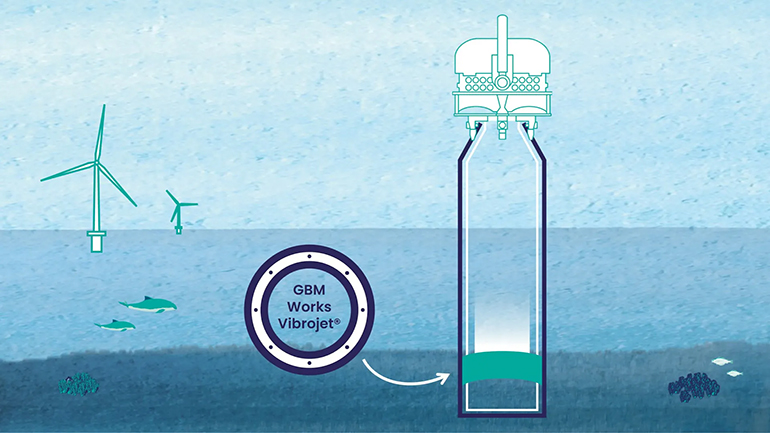
GBM Works and Ecowende have signed a contract for the installation of three monopiles in the 760MW Hollandse Kust West (HKW) 6 offshore wind farm using the former’s Vibrojet noise reducing technology.
The technique is based on the combination of vibrations on the top of the monopile with Dutch manufacturer GBM’s jetting technology inside of the structure. This combination of vibrations and jetting reduces resistance, making the installation more efficient and silent, minimizing the impact to marine life.
By selecting the Vibrojet for the demonstration in the three selected locations, Ecowende confirms its position as supporter and front runner of innovative techniques, on its mission to build the most ecological wind farm yet, said the Shell and Eneco joint venture.
“We are enthusiastic to work closely together with GBM to develop its fixed Vibrojet system for actual use during the construction of our wind farm,” said Ecowende engineering manager Arnold Reijnders.
“We hope we are able to deliver an important contribution in making the next generation windfarms more eco-friendly.”
Besides the ecological benefit of being more silent, there are several operational benefits to the system, said Ecowende. In comparison to the traditional impact hammer, the Vibrojet allows monopiles to be installed quicker. It also allows them to be installed deeper than by just using the Vibro-hammer.
“Hollandse Kust West represents our entrance to the offshore installation market and we are proud to contribute to Ecowende on its ecological ambitions,” said GBM Works business development director at Marcelo Werneck.
“By installing the three monopiles, we will prove the value of Vibrojet installations, an important step towards broader application of the technology on future projects.”
The scope of the contract includes, amongst others, engineering and manufacturing of the jetting system and offshore support during the installations. To execute the project, GBM Works is also working closely with Ecowende’s partners Van Oord, SIF and Ramboll.
In addition to the contract for HKW, Ecowende is also supporting GBM Works in the development project Simple 3, by providing funds and the opportunity to test the technology in HKW.
In the scope of Simple 3, to be delivered ahead of HKW, the Vibrojet will be tested in pilot scale offshore and noise measurements will be made to quantify the sustainability benefits. The tests will take the technology to readiness level 7.
“The Simple 3 project has been designed to allow the Vibrojet technology to be assessed in an offshore setting closely resembling conditions at HKW, intending to mitigate operational risks during the commercial installations,” added Werneck.