


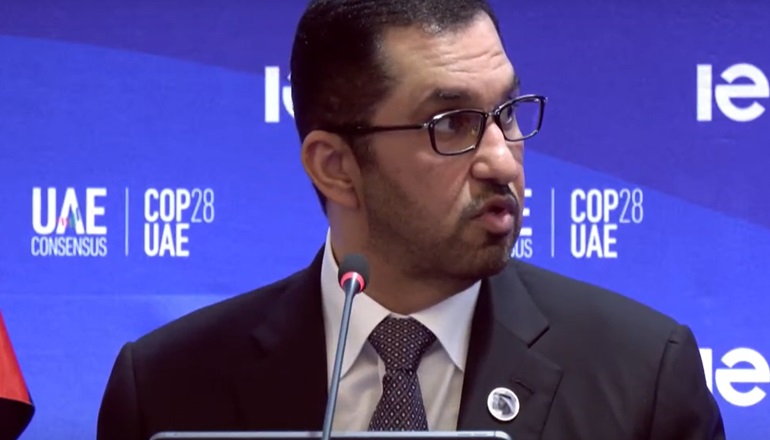
Implementation of the measures agreed at COP28 that aim to keep the average global temperature rise below 1.5°C will require “unprecedented action” by global stakeholders, COP28 President Sultan Al Jaber said.
Speaking at an event at the Paris headquarters of the International Energy Agency (IEA), Al Jaber said the measures, known as the UAE Consensus, “raised the bar and set a clear path to keep our north star of 1.5°C within reach”.
The UAE Consensus included an agreement to transition away from fossil fuels, a target to triple renewable energy capacity by 2030, and a commitment to end deforestation in the same period.
The event, “Beyond COP28: Time to Unite, Act, and Deliver the UAE Consensus”, was attended by ministers, ambassadors, industry executives and other leaders, including Fatih Birol, Executive Director of the IEA, Laurent Fabius, COP21 President and John Kerry, the United States Special Presidential Envoy for Climate.
Al Jaber said at COP28 “solidarity overcame polarisation, inclusivity prevailed over finger-pointing and the spirit of partnership brought the best of humanity together”, which was key to achieving the UAE Consensus.
He asked attendees “to keep this spirit alive and build on the momentum achieved at COP28”.
He added that all parties who signed the UAE Consensus must work on enhancing their Nationally Determined Contributions (NDCs), ahead of the next cycle in 2025.
“That work needs to start right now.
“They need to adopt comprehensive economy-wide emission reduction targets, that cover all greenhouse gases, are aligned with the science and keep 1.5°C in reach.”
He said that COP28 pushed the oil and gas industry to step up, with 40% of global oil production committing to zero methane emissions by 2030 and net zero by or before 2050.
While describing these targets as “a good start”, Al Jaber said “It must be built on” and that he would continue to “push for more”.
Al Jaber warned that the “energy transition will lead to energy turmoil, if we only address the supply side of the energy equation”.
Addressing the demand side will “require smart policy incentives to commercialise nascent zero carbon alternatives for heavy industry, like hydrogen”.
He said: “It will require massive investment in grid infrastructure to deliver renewable energy to the end user. And it will require governments and all relevant parties to be honest and transparent about the costs and trade-offs involved.”