


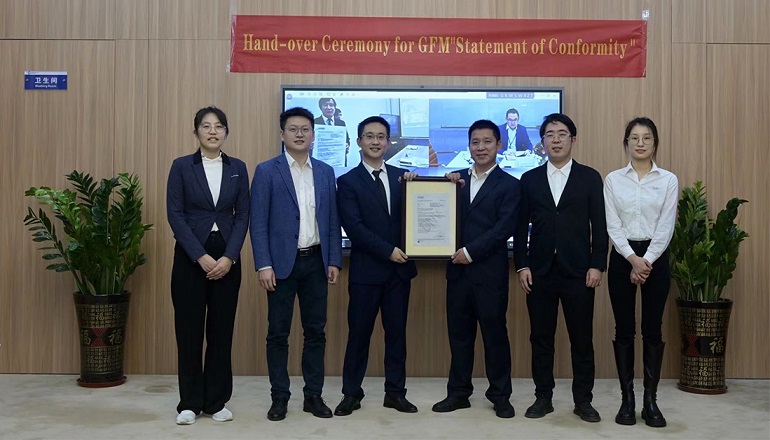
DNV has awarded two statements of conformity to Mingyang Smart Energy Group and Hopewind Electric for turbines that meet future grid rules.
The statements confirm that Mingyang’s turbine, which includes a wind power converter from Hopewind, have been independently verified to comply with the requirements of a grid forming converter.
Turbines with grid forming converters will become an increasingly important requirement of grid operators as more variable wind generation is connected to power grids.
It means that wind farms will be able to provide voltage and frequency stability services often provided by fossil fuel power plants.
The verification tests were performed in DNV’s Digital Test Lab in Arnhem, the Netherlands with a mechanical and electromagnetic co-simulation controller hardware-in-the-loop (CHiL) testbench.
The setup combines validated mechanical models with real time electrical models and control replicas for testing under various grid and wind conditions.
The verification includes voltage forming properties of the wind power converter (WPC), its power quality characteristics in relation to grid forming, as well as inertial behaviour, fault ride-through capabilities and the device’s black start capabilities.
“The share of wind power in power systems has been increasing remarkably and the behaviour of converters will be a key consideration in power systems.
“We believe grid forming technology will significantly improve the stability of modern power grids with the integration of large-scale wind power breaking the wind power penetration limitation.
“A mechanical and electromagnetic co-simulation controller hardware-in-loop platform is an important development tool, which can significantly improve the efficiency of technology development and verification, while reducing investment,” said Binwei Tang, Director of Grid Integration Technology Department at Mingyang Smart Energy.
Theo Bosma, Programme Director, DNV Group Research and Development, added: “DNV is continuously investing in R&D and we are committed to make real time digital simulation and testing practical for use in advisory and verification.
“This cooperation with Mingyang and Hopewind is a great example of the value that controller hardware-in-the-loop can bring to the highly innovative wind industry.”