


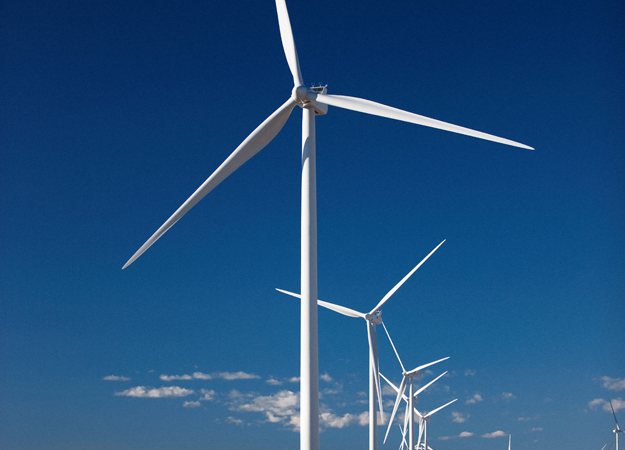
WindEurope is calling for a Europe-wide landfill ban on decommissioned wind turbine blades by 2025.
The move also includes a commitment from the European wind industry to re-use, recycle, or recover 100% of decommissioned blades.
It comes after several industry-leading companies announced ambitious plans for blade recycling and recovery.
A landfill ban would further accelerate the development of sustainable recycling technologies for composite materials.
Speaking at the Spanish Wind Energy Association (AEE)’s Annual Congress WindEurope chief executive Giles Dickson and general director of Asociación Empresarial Eólica (AEE) Juan Virgilio Márquez called upon the European Commission to propose a Europe-wide ban on landfilling decommissioned wind turbine blades.
The ban should enter into force by 2025 and also apply to other large composite components in the nacelles of modern wind turbines.
At the same time the industry commits not to send decommissioned blades from Europe to other countries outside of Europe for landfilling.
Dickson said: “Wind energy is a green technology. Sustainability is part of our DNA.
“That’s why we are constantly striving to further reduce our impact on the environment.
“A ban on landfilling wind turbine blades will help accelerate the development of sustainable recycling technologies.
“Austria, Finland, Germany, and the Netherlands already have a landfill ban in place.
“But we call upon the European Commission to propose a harmonised European approach.”
Today the standard lifetime of an onshore wind farm is around 20-25 years and 85-90% of the total mass of a wind turbine can already be recycled.
Most of the components – including steel, cement, copper wire, electronics and gearing – have established recycling circles.
However, wind turbine blades are more challenging to recycle.
They contain complex composite materials – a combination of reinforced fibres (usually glass or carbon fibres) and a polymer matrix.
These composites boost the performance of wind turbines. They allow for lighter and longer blades with optimised aerodynamics.
But their configuration also poses challenges for recycling.
Such composites are not only used in wind turbine blades.
They are important materials in sectors such as aviation, automotives, marine transport, aeronautics, leisure and sports equipment, construction and building.
There are some technologies available to recycle the composite materials in blades, and an increasing number of companies offer composite recycling services, but these solutions are not yet mature enough, widely available at industrial scale and/or cost-competitive.
Making these technologies commercially viable will require commitment from policy makers, other composite users and the recycling industry.
Marquez added: “As an industry we are determined to be at the forefront of sustainability and circularity.
“Wind turbine blades are non-toxic and landfill safe but we believe landfilling is a waste of valuable resources.
“Our commitment to end the landfilling of wind turbine blades by 2025 will help to make sustainable recycling methods commercially viable.
“Spain is the second biggest market for wind energy in Europe.
“The Spanish wind energy sector joins this initiative proposed by WindEurope.
“From Spain we are sending a sign that the industry is committed to step up its efforts towards 100% circular wind turbine blades.”
As a next step, the wind industry will develop a roadmap, further detailing the steps required to accelerate wind turbine blade circularity.
In doing so we will closely collaborate with the chemicals industry, as a provider of innovative chemical recycling solutions, as well as other composite using industries, such as the boating industry.