


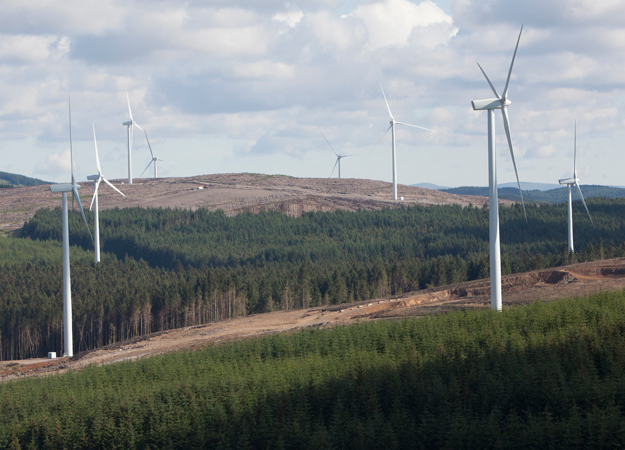
Extensions and repowering of existing onshore wind farms could play an important role in helping the UK meet its 2050 net zero target, according to analysis by Cornwall Insight.
The current 13GW onshore wind fleet could start to reduce in size from 2027 when many Renewable Obligation Certificate (ROC) accreditations end, if repowering is not undertaken, the analyst outfit said.
It also pointed out that repowering and extensions of existing onshore wind sites in the UK have “yet to receive the same attention” from policymakers as greenfield wind farms.
Cornwall Insight wholesale manager James Brabben said: “The trends show how some existing site owners are gearing up for the new world of onshore wind development.
“With an ageing existing fleet, this area is set to become a very active space, with sites needing to be very efficient to be viable.
“Our analysis here of capacity rises shows the potential for repowering and site extensions to play an important role in underpinning net zero in the power sector.”
Cornwall Insight’s ‘Renewables pipeline tracker report’ highlighted that applications for repowering and extensions of operational wind farms have increased as existing projects start to age.
Around 20 projects in total, equating to 665MW, have applied for planning permission for extensions and repowering to existing sites.
Most of the sites are in Scotland.
Of the 20 sites, 16 are classified as extensions with four considered full repowerings.
Overall, the four repowering projects have capacity gains against original sites totalling 223MW.
“For both extension and repowering projects, there is a clear trend of a significant reduction in the turbine count alongside a material increase in turbine capacity, demonstrating a real value add to the net zero push arising from these sorts of activities,” Cornwall Insight said.
Brabben said: “Cornwall Insight’s forecast shows that between 2027 and 2030 up to 3.6GW of existing onshore wind assets could drop out of the Renewable Obligation scheme, with the majority approaching the end of an assumed 20-25 year economic lifespan, making repowering and extensions key to meeting GB’s net zero goal.
“The time taken to obtain planning permission and grid agreements for new build assets can be lengthy, and developers and project owners understand this all too well. Repowering assets is, therefore, an attractive option.”
The analysis found that sites are using newer and bigger turbines with the average turbine capacity for new sites up 3MW compared to 1.9MW for existing sites. One example is Hagshaw Hill where there is a 5MW increase in average turbine capacity.
“It is not just about higher capacity, but also about higher efficiency and load factors arising from the adoption of the latest technology and improved site layout. These projects deliver higher low carbon output generally.
“The vast majority of projects show a clear reduction in the number of turbines being utilised too, with an average of just 9.5 per site against 21 for existing sites.
“Fewer turbines should help planning, although other factors such as tip height and wider visual impacts are also very important.”