


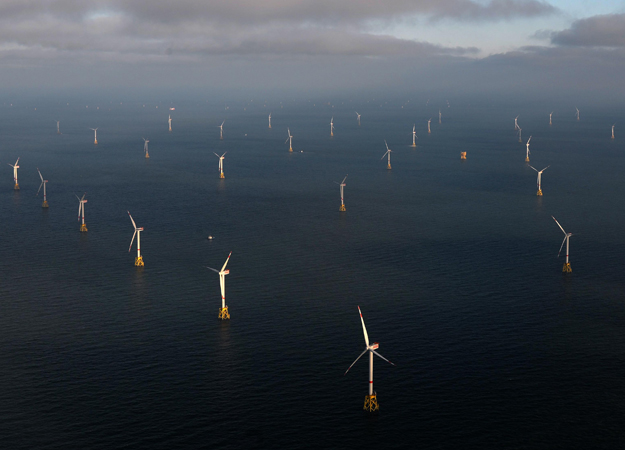
German offshore wind energy associations BWO and WAB have penned a joint letter to the government pressing for a long-term reliable financing framework for projects.
In the letter to the Federal Ministry of Economics and Energy the groups highlight the role of the offshore wind industry in “taking responsibility for the rapid recovery and reconstruction of the German economy”, post-coronavirus crisis, and in the “spirit” of the European Green Deal.
BWO managing director Stefan Thimm said: “Only if the 20GW offshore wind by 2030 target is finally anchored in law, will we have a realistic chance of achieving our climate targets at all.
“Our member companies and the authorities involved urgently need planning and financing security. Electricity from offshore wind energy is now more cost-effective than almost any other technology, and the introduction of Contracts for Difference will make it possible to reduce electricity generation costs by another 30% compared to refinancing via power purchase agreements.
“Stable investment conditions based on CfDs would not only strengthen domestic small and medium-sized businesses, but also relieve the burden on the consumer and thus strengthen the international competitiveness of electricity prices.”
In the letter the two associations ask for long-term expansion targets up to 2035 at least and the development of a domestic market for green hydrogen from offshore wind.
WAB managing director Heike Winkler said: “For electricity production costs to continue to fall, long-term planning and a complete supply chain are needed -this creates jobs and enables the cost-effective expansion of offshore wind.
“Maintaining and expanding our complete innovative supply chain is therefore in our national economic interest -as well as in the business interests of larger industry players and small and medium-sized businesses in Germany.”
The groups want to see the first offshore wind projects put out to tender at short notice. In the medium term, they stated 2GWof new annual capacity additions is realistic and have urged its inclusion in the Wind Energy at Sea Act (WindSeeG).
“Due to the expansion gap that has already arisen and the jobs that have been lost as a result, as well as generally longer planning cycles, we need immediate targets for the period after 2030 in line with the ‘Bremen Declaration'”, said Winkler.
She said targets should also apply to the generation of electricity and green hydrogen.