


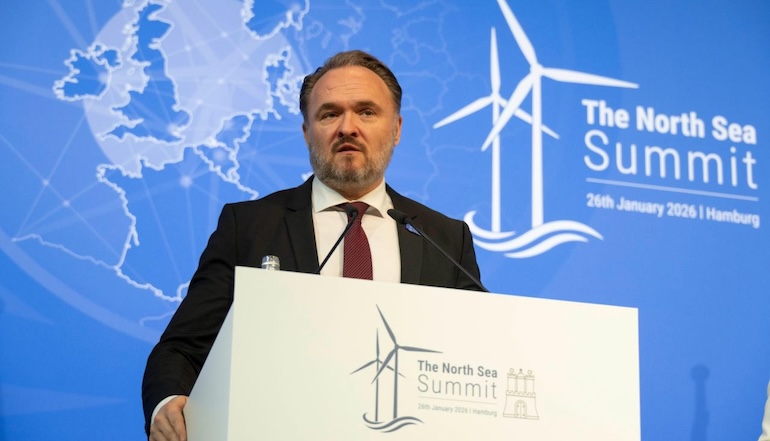
German offshore wind group BWO has welcomed the outcomes of the North Sea Summit in Hamburg, arguing that the agreements made by North Sea governments, industry and grid operators provide urgently needed stability, clearer investment signals and a stronger European framework for offshore wind expansion.
The association said the summit delivered a new Offshore Wind Investment Pact under which governments intend to tender 15GW of offshore wind annually between 2031 and 2040 within an optimised, lower-risk auction framework.
It added that at least 10GW per year will be backed by indexed, two-sided Contracts for Difference to provide market predictability and secure long-term investment conditions.
BWO said reliable tender volumes and a stable auction design are essential to trigger investment across projects, supply chains, ports, vessels and the workforce.
“The North Sea Summit in Hamburg marks a milestone for offshore wind energy in Europe,” said Hans Sohn, head of policy and communications at BWO.
“The European states are moving closer together in the North Sea and deepening their cooperation – that is a very good signal. It is clear that offshore wind, as a central pillar of the energy supply, supports a more resilient Europe. The political commitments to clear expansion pathways and reliable auctions create the planning certainty that is urgently needed and form the basis for investment, falling costs and a strong European offshore wind industry.”
BWO also signed the Offshore Wind Industry Declaration alongside WindEurope and companies across the value chain, backing the long-term European target of 300GW of offshore wind.
The association said the sector commits to reducing the levelised cost of electricity from offshore wind by 30% in real terms by 2040 compared with 2025 investment decision levels.
It added that the industry plans major investment in manufacturing capacity, infrastructure and training to support European value creation and jobs.
BWO said Germany’s move towards two-sided Contracts for Difference will lower financing costs and deliver cheaper electricity.
“We are committed to ensuring that no further auction is held under the previous rules,” Sohn added.
“The auction planned by the federal government for June 2026 for the areas that nobody wanted in August 2025 should be postponed and held under a new auction design.”
He said the UK provides a strong example following its recent successful CfD-based auction.
The association said the protection of critical energy infrastructure was a central topic at the summit, noting that offshore wind farms form a key part of this infrastructure.
It argued that maritime security is a basic requirement for stable and economically viable offshore wind operations, linking public safety, economic performance and security of supply.
BWO said changing security expectations must be reconciled with long-term investment realities and require clarity around responsibilities, costs and liability.
It called for early and structured dialogue between operators, authorities and security bodies to deliver a security-by-design approach.
“The BWO is recognised by security authorities as a central point of contact – and rightly so,” said Irina Lucke, BWO chair.
“Operators of offshore wind farms bear responsibility for critical infrastructure over project lifetimes of 25 years and more and share the goal of a secure maritime environment. We are ready to contribute our existing capabilities. However, dialogue is essential to achieve clear objectives, reliable responsibilities and a technically and economically sustainable implementation.”
A new Fraunhofer IWES study commissioned by BWO and BDEW highlights the benefits of more cross-border offshore planning.
The association said the analysis shows that a transnational approach to site development for a 70GW German offshore build-out can reduce shading effects, increase energy yield by up to 13% and cut levelised costs by up to 11%.
BWO said the findings underline that deeper European cooperation is both economically beneficial and energy-politically necessary.