


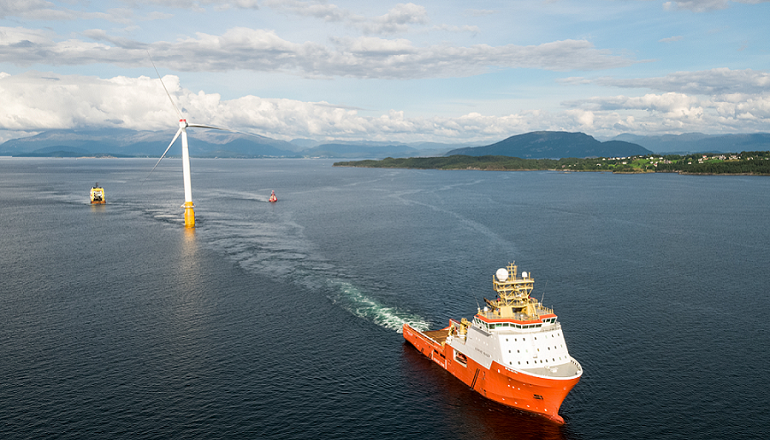
The Offshore Renewable Energy (ORE) Catapult has launched a new multi-million euro floating offshore wind centre of excellence to accelerate the development of next generation offshore wind.
The initiative is backed by up to £500,000 (€580,000) in funding each, from the Scottish government and ORE Catapult’s Wales-based Marine Energy Engineering Centre of Excellence (MEECE), match funding from industry plus local government support from Cornwall and Isles of Scilly.
ORE Catapult said the aim is to develop an “internationally recognised” centre of excellence to cut the cost of energy from floating wind, accelerate the build out of floating wind farms.
The centre will also create opportunities for the UK supply chain, and drive innovations in manufacturing, installation and operations and maintenance, according to ORE Catapult.
Eight initial projects will kick-start the centre’s activities.
These include using floating wind turbines to power offshore oil platforms, hybrid bottom fixed-floating offshore wind, grid connection for Scottish offshore wind and off-grid opportunities including green hydrogen production, floating substructures for fabrication in Scotland and mapping a Cornwall and Wales floating wind supply chain.
ORE Catapult’s ‘Macroeconomic Benefits Report’, released in September 2018, and the joint Renewable UK and Scottish Renewables ‘Floating Wind – The UK Industry Ambition’ report released today, both identify Scotland, Wales and south-west England as key areas that could benefit from floating offshore wind, creating 17,000 jobs and generating £33.6bn for the UK economy by 2050.
Announcing the launch at today’s Renewable UK/Scottish Renewables Floating Offshore Wind Conference, Scottish Government energy minister Paul Wheelhouse said: “Scotland’s unique deep-water profile and significant expertise in oil and gas mean we are exceptionally well placed to take advantage of the huge economic opportunity presented by early adoption of commercial scale floating projects.
“The Scottish Government is delighted to support ORE Catapult’s Floating Wind Centre of Excellence to further develop this technology and drive down costs in the sector.”
Chris Hill, ORE Catapult’s operational performance director, said: “According to International Energy Agency estimates, the next generation of floating turbines could generate enough energy to meet the world’s total electricity demand 11 times over in 2040.
“We’ve already had strong interest from more than 10 offshore wind developers, including Total, Equinor, Mainstream Renewable Power and EDP Renewables, along with three UK universities, in joining the initiative, and are closely aligning the centre’s activities with key stakeholders including Welsh Government, the Celtic Sea Cluster, Opportunity North East, the Oil and Gas Technology Centre, the Deepwind Offshore Wind Cluster, Scottish Enterprise, Cornwall and Isles of Scilly Local Enterprise Partnership, Highlands and Islands Enterprise and Crown Estate Scotland.”
MEECE programme manager Paul Ellsmore said: “There is huge potential for floating wind off the coast of Wales, representing a major opportunity for the Welsh supply chain companies and the Welsh Economy.
“Floating wind will form a cornerstone of MEECE activity and, working with our university partners, we will be driving synergies across wind, wave and tidal to accelerate growth across these key components of offshore renewables.”