


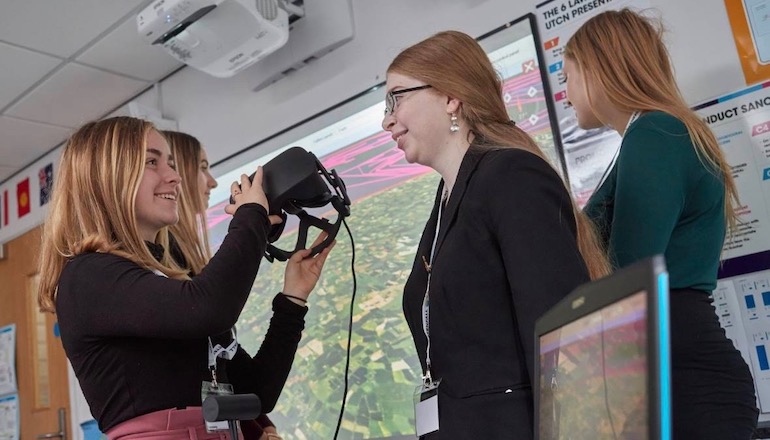
Sixth form students from Norfolk in England are travelling to the Netherlands this week to use 3D virtual reality technology to showcase jobs in the offshore wind sector.
Vattenfall’s young ‘consultants’ – A level students at the University Technical College Norfolk – will deliver the company’s first international skills ‘export’ sessions to 50 students at two specialist technical colleges offering insights into the roles and skills needed to build a wind farm.
The company hopes the peer-to-peer mentoring programme will be rolled out for 15-19-year-olds at other Dutch colleges to spread awareness of offshore wind and its career opportunities.
Joanna Crane, 18, Maisie Hubbard, Sarah Milford and Jovita Beeston, all 17, are project leaders after adapting the hands-on technology as part of Vattenfall’s commitment to work with young people in areas where they have plans to develop wind farms.
Vattenfall is planning to build the Norfolk Vanguard and Norfolk Boreas projects off the coast of the English county.
The colleges involved in the Netherlands are the Nova College Beverwijk, west of Amsterdam, and Noorderpoort College, near Groningen.
The English students will outline the range of careers in renewable energy through the programme that gets student teams to design and pitch their own wind farm development.
They work with their Dutch peers, who will take roles including project manager, design lead, environmental consultant, stakeholder manager, to build a virtual wind farm, plot turbine sites, consider technology choices, environmental matters and address challenges developers face in real life.
They will then fly through the finished wind farm using a virtual reality headset.
Vattenfall said the team’s experiences will go on to shape its senior management’s decision about the programme’s roll-out further afield.
Crane said she has shifted her career path from maths to engineering thanks to the knowledge, skills and networking opportunities gained at Vattenfall.
“Our work in the Netherlands is to show them how Vattenfall’s culture of valuing young people is so important for the future and to try to change people’s attitude to engineering,” she said.
Vattenfall local liaison officer and skills champion Susan Falch-Lovesey said engineering was suffering a shortfall of 20,000 new people every year, with only 12% of professional engineers are women.
She said: “At Vattenfall, we want to recruit the best people and have the benefits proven from a balanced workforce.
“We really want young people in the East of England to have opportunities from the growth of the wind industry. It also shows them that you don’t have to be 40 or 50 to be a consultant and have your expertise appreciated in this new economy.”