


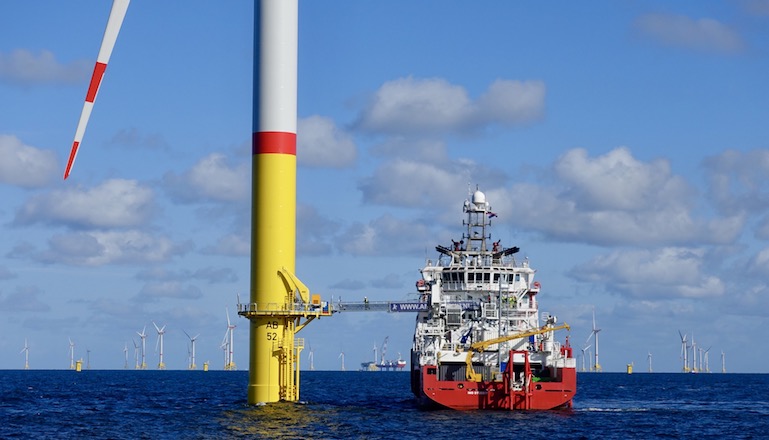
The global offshore wind operation and maintenance (O&M) market is expected to grow by 17% a year to €11bn by 2028, according to new research from Wood Mackenzie Power and Renewables.
Wood Mackenzie said Europe would be the largest contributor with €6.7bn in value, while the Asia Pacific region is keeping up the pace in O&M market size and spend.
Wood Mackenzie senior offshore wind analyst Shimeng Yang said: “We expect average OPEX across Europe to drop by 57% between 2019 and 2028, mainly driven by larger turbine ratings, improved turbine reliability, economies of scale in service due to larger-scale projects, new service practices and clustering opportunities.
“Turbine O&M costs constitute the biggest portion of offshore wind OPEX spend. Uncertainty caused by key component failures is further pushing costs upwards.
“As such, a proactive approach is highly emphasised to replace key components to reduce turbine downtime and associated revenue losses.”
Wood Mackenzie added that blade erosion and repair is a huge concern in the offshore space, causing an estimated 5000 days cumulative downtime globally and resulting in €61m of direct repair costs and lost revenue.
Wood Mackenzie principal analyst Daniel Liu said: “Both turbine design and harsh operating conditions are to blame for the erosion.
“Newer models have larger rotors for more energy output while leading to higher tip speeds.”
Other problems include subsea cable failures, while foundation defects can also be costly but are unlikely to extend immediate impact on operations, the researchers said.
There is also a growing demand for more-advanced installation vessels, as older vessels do not meet the specifications for installing larger turbine units.
Wood Mackenzie senior offshore wind analyst Soren Lassen said: “This trend has been further fuelled by an excess supply of installation vessels in the market, which is set to intensify in the mid-2020s when next generation turbines will start to be deployed.”
The research added that almost all offshore wind turbines use condition monitoring systems, though usage differs by turbine manufacturers.
Wood Mackenzie recommended that operators analyse the accessibility of offshore wind farms according to project characteristics.
“From energy production of wind farm, to logistics specifications, from metocean conditions to costs of operation, the result from the accessibility analysis will allow the operator to perform in a cost-effective way to ascertain the competitiveness of the selected logistic concept,” it said.
Wood Mackenzie also noted the increased use of helicopters to complement vessel use.