


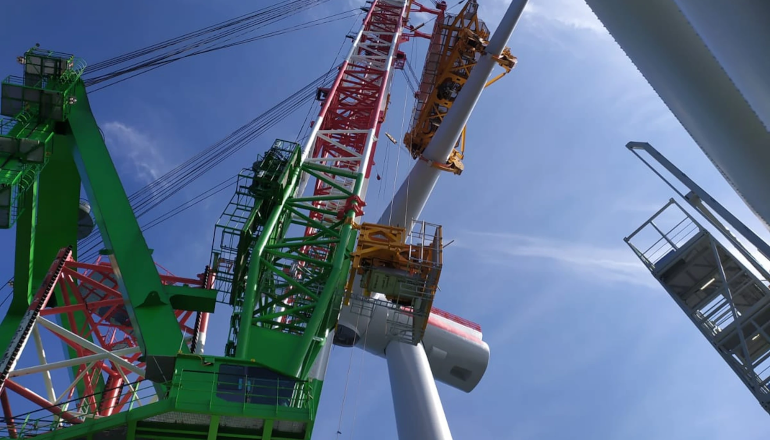
Belgium’s offshore wind fleet notched a new production record in 2021.
The country’s 399 turbines totalling a shave under 2.3GW exported almost 6.8TWh of electricity, up from 6.7TWh in 2020.
This 2021 total corresponds to the annual electricity demand of almost 2 million households, or 8% of the total electricity demand in Belgium.
It is estimated that, with the current share of offshore wind energy in the energy mix, the emission of 3 million tons of CO2 is avoided every year, according to the Belgian Offshore Wind Platform.
The record was achieved despite a lower capacity factor of 34.4%, down from the average 38%.
Poor wind speeds were to blame.
“Despite the drop in wind speed, wind farms were able to slightly exceed the 2020 production record (6.73 TWh) in 2021, as the wind turbines installed in spring and autumn 2020 were for the first time operational during the full year,” said BOWP.
In 2022, there will be no new wind farms in the Belgian North Sea.
The federal government is working on an amendment to the legislative framework for the tender for up to 3.5GW of additional offshore wind capacity in the new offshore wind zone, the Princess Elisabeth area.
When these new wind farms can become fully operational depends on the federal government for the legislation surrounding the tender procedure, and on the grid operator that must be able to guarantee the connection to the onshore grid, said the association.
According to the current planning, the announcement of the winners of the tender is expected in 2024 and 2026. The first wind farm with a capacity of 700MW could be connected by the end of 2026. The following farms could be connected from the beginning of 2028.