


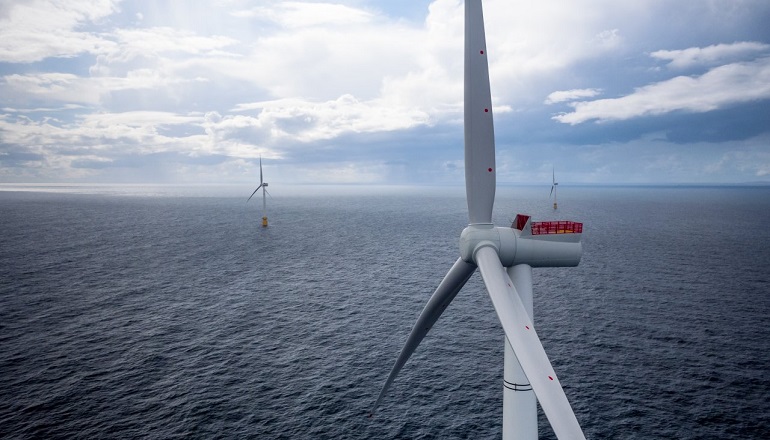
Floating offshore wind projects in the Celtic Sea could support 3200 jobs in south west England and Wales and bring £682m in benefits to the local supply chain by 2030, according to a new report from the Offshore Renewable Energy (ORE) Catapult.
The report – ‘Benefits of Floating Offshore Wind to Wales and the Southwest’ – was jointly commissioned by the Welsh Government and the Cornwall and Isles of Scilly Local Enterprise Partnership.
It models four separate floating wind sites in the Celtic Sea, with two off the Cornwall coast and two off the coast of west Wales.
Areas of activity include development and consenting, vessels and subsea engineering, electrical infrastructure, anchors, ports and logistics, and some manufacturing.
Spend could increase to £1.24bn if there is further investment in manufacturing facilities for mooring chains and cables, and port infrastructure to enable turbine substructure fabrication locally, rather than final assembly only, the report said.
The modelled sites include a four-turbine 32MW project using the repurposed Wave Hub test site 16km off the north coast of Cornwall in 2023/24.
The site is currently seeking a revised consent for floating wind, the report said.
A second project modelled is a nine-turbine 90MW scheme in the Pembrokeshire Development Zone, 15km from the Welsh coast in 2025/26.
A third 300MW, 12-turbine project could follow in 2027/28, some 40km off the south coast of Pembrokeshire, followed by a 500MW, 33-turbine project, 60km west of Cornwall that could be built by the end of the decade.
The report assumes that 15MW turbines will be available in the next 10 years.
ORE Catapult also noted that “these zones are presented as one possibility of high potential areas for future offshore wind development” but have not been endorsed by The Crown Estate.
“There is an opportunity to develop a local supply chain for Wales and the greater south west region that is well equipped to provide the foundation for, and then benefit from, the long-term opportunities associated with the build-out of floating offshore wind,” the report said.
Cornwall and Isles of Scilly LEP chief executive of the Glenn Caplin said: “For 18 months we have been leading an initiative to secure floating offshore wind deployments in the Celtic Sea, building on our area’s maritime and offshore renewable energy expertise.
“The Celtic Sea is one of only two UK locations where floating offshore wind turbines will be deployed at scale, the other being Scotland.
“This report, which we have jointly funded with the Welsh government, sets out in detail the significant economic and jobs benefits that would accrue to our respective regions.
“The scale of the Celtic Sea resources are of national significance, with potential to make a major contribution to the UK’s offshore wind and climate change targets.
“The LEP and industry are now engaging with government on potential revenue support mechanisms that would help us unlock this exciting new industry for the UK.”