


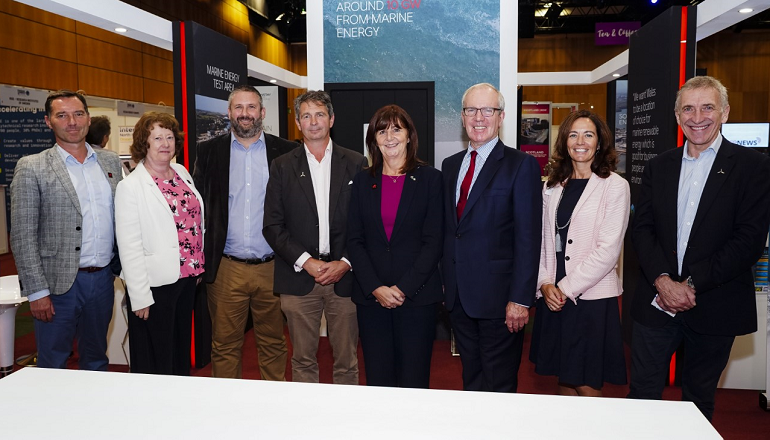
Ireland, Wales and the south-west England county of Cornwall have signed a collaboration agreement outlining a commitment to work together to progress floating wind projects in the Celtic Sea.
The Celtic Sea Alliance has been set up to progress floating wind in the region.
The Cornwall and Isles of Scilly Local Enterprise Partnership (LEP), Marine Energy Wales and Marine Renewables Industry Association Ireland, signed the agreement, which formalises a relationship that will focus on benefits of floating offshore wind including low energy generation and job creation.
The Celtic Sea can potentially deliver one third of the UK’s additional renewable energy requirements whilst supporting low carbon targets, according to the alliance.
Welsh Minister for Environment, Energy and Rural Affairs, Lesley Griffiths said: “We know that floating offshore wind as a technology has long-term potential for delivering multi-GW scale deployment in the future. I am pleased Wales is taking part in this alliance so we can explore the economic opportunities of this technology and maximise the collaborative opportunities in the area of the Celtic Sea.”
Irish Minister of Communications, Climate Action and Environment, Richard Bruton, added: “I welcome the launch of the Celtic Sea Alliance project and the signing of an MoU between Ireland, Wales and Cornwall … Ireland’s Climate Action Plan puts in place a decarbonisation pathway to 2030, putting us on a trajectory to net zero emissions by 2050.
“Offshore wind will be a major component of this target and the work undertaken by the Celtic Sea Alliance will be key to realising our shared ambition of a low carbon economy.”
Cornwall and Isles of Scilly LEP non-executive director Steve Jermy added: “We’re delighted with this important political development, which builds on the floating offshore wind initiative begun 18 months ago and led by the Cornwall & Isles of Scilly LEP.
“The initiative has been given new momentum with the announcement of climate emergencies, both nationally by British, Welsh and Irish Governments, and regionally by Cornwall Council.
“As well as the opportunity to contribute to meeting national and international zero carbon targets, floating offshore wind can bring coastal development, jobs and export opportunities to the south west, Wales and Ireland, in the same way that fixed offshore wind has to the East of Britain.”
The Celtic Sea Alliance is working actively with national, devolved and local governments on the best approach to deliver floating wind projects.
It has attracted support from local stakeholders.
Next steps for the alliance include the formation of a Celtic Sea offshore wind industrial cluster, continuing policy engagement to secure a pipeline of at least 1GW worth of floating wind turbines in the Celtic Sea before 2030, which would in turn attract in excess of £2Bn worth of regional investment.