


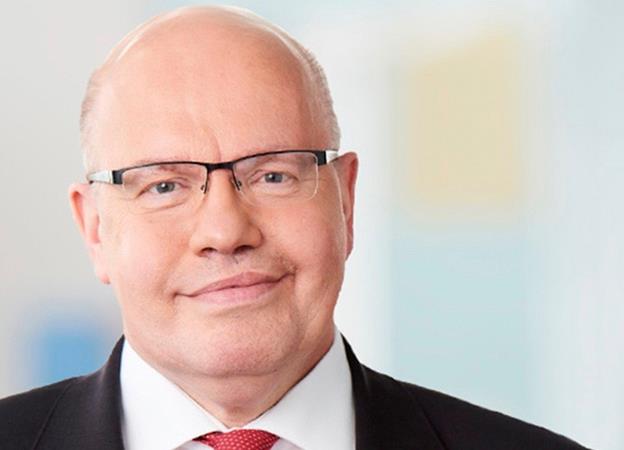
Germany’s economics and energy minister Peter Altmaier today called for the development of joint offshore wind projects in the EU to be one of the priorities for the region’s energy sector.
Altmaier (pictured) made the call ahead of meeting of the European Energy Council, where the new European Commission will present priorities for the energy sector.
“In my view, the priority for the further development of the EU energy regulatory framework is the increased development of joint offshore wind energy projects and the further development of gas market design and the promotion of sectoral coupling,” he said.
The new European Commission will be led by Ursula von der Leyen, who took office on 1 December.
Kadri Simson is the new commissioner for the EU’s energy portfolio.
Meanwhile, Energy Ministers from North Seas countries met earlier today in Brussels and agreed a 2020 Work Programme on offshore wind deployment as a means of reaching climate neutrality by 2050.
This included developing plans for potential joint cross-border offshore wind farms that “generate benefits for all participating parties”.
The 10 North Seas Energy Cooperation countries – Belgium, Denmark, France, Germany, Ireland, Luxembourg, the Netherlands, Norway, Sweden and the UK – agreed at their Ministerial meeting in Esbjerg in June 2019 to broaden the scope of their cooperation.
The 2020 Work Programme will elaborate what the countries intend to do together on maritime spatial planning, electricity grids and developing hybrid and joint offshore wind farms.
The 10 countries have committed to define a regulatory framework for offshore wind farms that have a grid connection to more than one country.
Such hybrid projects will be key in pooling assets and infrastructure together and reduce the costs of deploying offshore wind, said trade body WindEurope.
The countries will collaborate on maritime spatial planning to “be able to utilise the energy potential of the North Seas” because space in the North Seas is finite.
They aim to better coordinate the planning and development offshore and onshore electricity grid expansion in order to facilitate the expansion of offshore wind.
WindEurope chief execuive Giles Dickson said: “Up to 380 GW of offshore wind is doable in the North Seas by 2050 if countries collaborate effectively on maritime spatial planning, grid investments and hybrid offshore projects.
“The North Seas countries realise that and are taking concrete steps to make these big volumes happen.
“It’s great to see this reinforced commitment from Governments on offshore wind – and to see them widening and deepening the scope of their work together.
“This is Europe at its best. And a great example for other regions in particular the Baltic to follow.”