


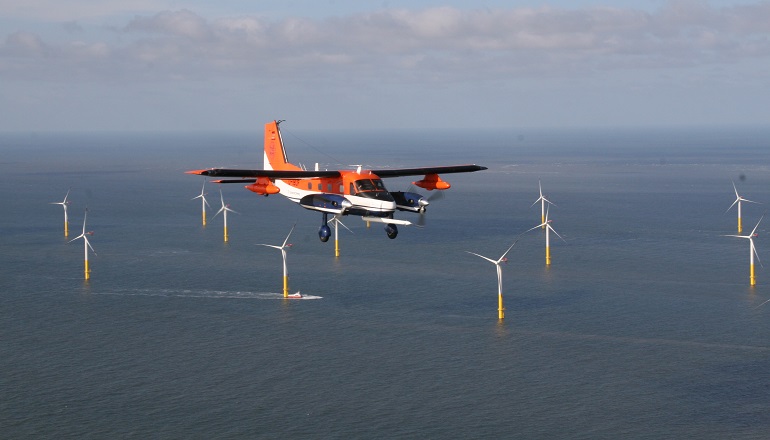
A three-year research project is investigating how wind conditions in the German Bight could change if offshore wind farms are expanded on a large scale.
The €3.4m ‘Interaction Between the Wakes of Large Offshore Wind Farms and Wind Farm Clusters With the Marine Atmospheric Boundary Layer’ (X-Wakes) research project, is funded by Germany’s Federal Ministry for Economic Affairs and Energy.
Within the scope of X-Wakes Fraunhofer Institute for Wind Energy Systems (IWES) and other academic researchers will investigate how the wind conditions in the German Bight could change if offshore wind farms are expanded on a large scale.
The project team will use data from extensive measurement campaigns and high-fidelity modelling approaches to improve industry models that are afterwards used to analyse the impact of the offshore wind farm cluster expansions.
The wind blows more continuously and powerfully at sea, but the area of the German Bight available for wind energy use is limited, so wind farms are usually constructed in groups, known as clusters, each comprising several hundred wind turbines.
However, wakes with lower wind speeds and heavy turbulence develop behind the turbines, while upstream the wind speed is reduced due to blockage effects.
According to X-Wakes researchers, turbines located in these wakes produce less energy and are exposed to greater loads. Under certain atmospheric conditions, wakes can extend for distances in excess of 50km.
Fraunhofer IWES project coordinator Martin Dorenkamper said: “In our X-Wakes research project, we want to investigate these wakes and other accumulative effects such as the global blockage effect in more detail and discover how the wind farm clusters influence each other as well as what consequences a large-scale expansion of the offshore wind farm would have on wind conditions in the future.
“We hope to use the data gathered during the project to further develop our existing models in order to be able to predict the yields of the wind farms for future expansion scenarios under realistic conditions.”
The researchers are employing stationary measurements at different locations in the German Bight, such as on turbines and converter stations. Satellite-based remote sensing data will support the large-scale analysis of the extent of the wakes.
“In addition, measuring campaigns with a research aircraft at low altitude also deliver high-resolution meteorological data,” said Astrid Lampert from TU Braunschweig, another X-Wakes research partner.
Industrial partners supporting X-Wakes include Vattenfall, RWE Renewables and Tennet, which are providing wind farm data and access to their offshore infrastructure for measurements.
The other academic partners include Karlsruhe Institute of Technology and the University of Oldenburg with the Centre for Wind Energy Research.