


The German government must take greater account of the needs of the energy transition in its new ports strategy, the country’s Federal Wind Energy Offshore Association (BWO) has argued.
The comments come after the German government presented its new port strategy, which contained a collection of measures, but no plans for financing.
BWO said that the strategy strengthened the competitiveness of Germany as a port location.
It also contains many important and targeted measures, including accelerated and simplified land provision and approval procedures, as well as initiatives to attract and train skilled workers.
Nevertheless, it must be emphasized that the German government is not living up to its responsibility with regard to its most important goal of making ports sustainable hubs of the energy transition, BWO claimed.
It said that the energy transition has been politically decided by the federal government and represents a national task that threatens to be significantly slowed down without the expansion of the necessary port capacities.
In the coalition agreement, the Federal Government has committed itself to the fact that it and the Länder share responsibility for the necessary port infrastructures.
BWO said, in this context, the port of Cuxhaven in particular is of particular importance in the short term.
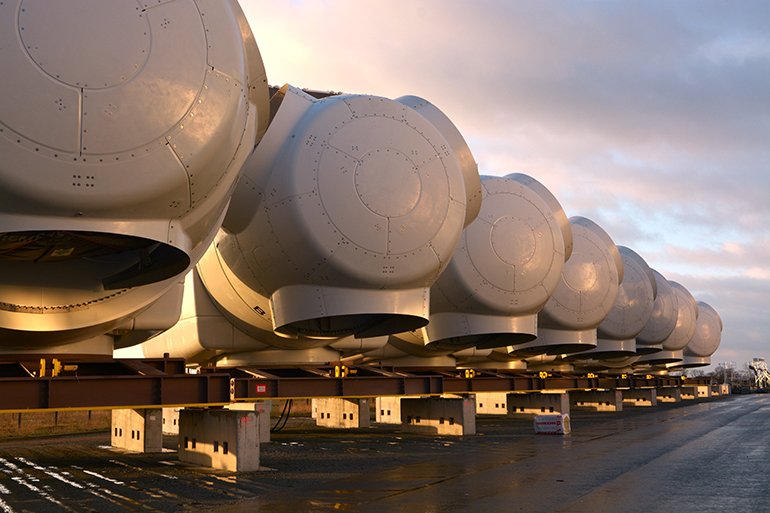
Around 80% of all rotor blades installed in Germany land in Cuxhaven (pictured), both for onshore and offshore turbines.
BWO, the Federal Wind Energy Association (BWE), WAB and Wind Energy Network (WEN), the non-profit foundation Offshore Windenergie and the Renewable Energy Cluster Hamburg, said in a statement: “We have already pointed out several times that capacities are already running out in Cuxhaven.
“Cuxhaven is the only German deep-sea port that already has a planning approval decision for the expansion of its areas; this is the only place where the urgently needed capacities can be quickly expanded.
“Nevertheless, the financing of the project has still not been conclusively clarified because the federal government is not facing up to its task here.
“The German government must take greater account of the needs of the energy transition.
“It must now create a coherent and stable financing basis for the port strategy as quickly as possible, which sustainably underpins the goals it has set itself from the coalition agreement.”