


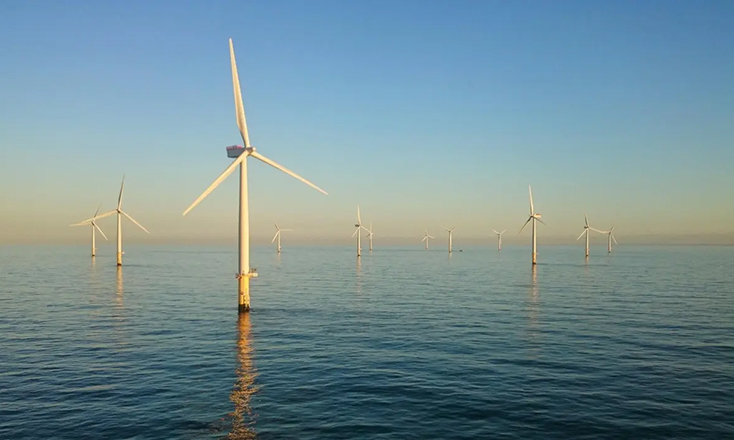
Equinor is collaborating with Scottish Government Directorate Marine Scotland to better understand how fishers can safely operate around and within floating offshore wind farms.
Equinor sustainability advisor Monica Fundingsland said: “Floating turbines are anchored to the seabed via dynamic mooring chains.
“Vessel data has shown that fishers are avoiding our floating offshore wind farm, so we are working closely with Marine Scotland to better understand how fishers can safely fish within a floating wind farm using a variety of techniques.”
In a survey scheduled at Hywind Scotland for 2022, Marine Scotland will test three kinds of fishing gear; creels, fishtraps and jigging lines.
Whilst not all of these fishing methods are used commercially around Hywind Scotland itself, the purpose is to demonstrate how methods used globally can interact with floating offshore wind farms.
Using floating turbines means that wind farms can be built in deeper waters, either further out to sea where wind speeds are more consistent, or around coastal areas too deep for fixed bottom foundations.
Equinor’s Hywind Scotland is the world’s first floating offshore wind farm and began producing electricity in 2017.
Since then it has consistently outperformed other UK wind farms, said Equinor, achieving the highest annual average capacity factor (how much electricity is actually generated as a percentage of what the wind farm would generate if at full power all the time) in the UK since operations started.
Equinor said it is capturing as much data from the floating wind farm as possible to further apply and share this knowledge globally around floating offshore wind.
Earlier in June, a trial survey allowed Marine Scotland to test some of the equipment, in preparation for next year’s survey.
Jared Wilson, renewables and energy programme manager at Marine Scotland, said: “As home to the world’s first floating offshore wind farm we are very keen to leverage this position to understand more about how fishers can continue to work safely alongside offshore wind.
“The results and lessons learned from this initial two day trial will help us inform the approach taken for the larger trial next year.”
The full survey is expected to take place over the second and third quarters of 2022.