


The US Department of Energy (DOE) has awarded 13 projects a share of $28m to advance wind energy across the country.
Two offshore wind demonstration projects will receive up to a total of $10m to conduct additional project development activities.
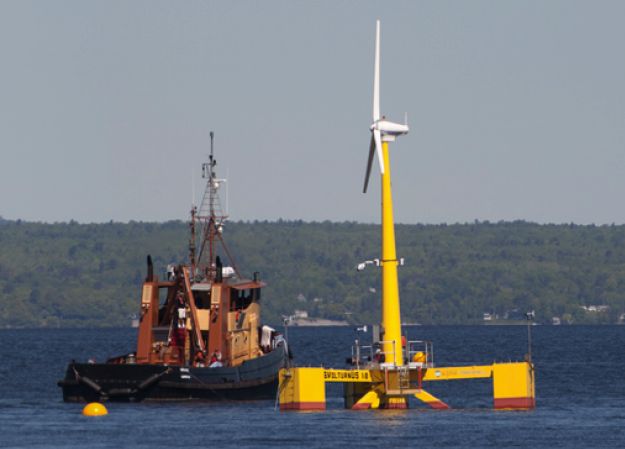
The Lake Erie Energy Development Corporation in Ohio will use state-of-the-art sensing technologies to characterise the activity of birds near the Icebreaker project site, while the University of Maine will develop an alternative floating substructure design for a 10–12MW turbine in place of the currently planned two 6MW machines for the Aqua Ventus 1 floating offshore wind demo off Monhegan Island.
Four wind innovations for rural economic development (WIRED) projects will receive a total of $6m.
Bergey WindPower of Norman, Oklahoma will develop a standardised distributed wind/battery/generator micro-grid system.
The Electric Power Research Institute in California will develop novel modeling, planning, and operation methods for deploying and operating wind energy and battery storage technologies that allow increased wind energy while maintaining rural grid reliability.
Iowa State University will design optimisation models and control algorithms that help rural utilities leverage distributed wind in coordination with other distributed energy resources such as battery storage and solar.
The National Rural Electric Cooperative Association of Arlington, Virginia will provide technical assistance and develop standardised wind engineering solutions, metrics, case studies, best practices, and finance models to help rural cooperatives cost effectively adopt distributed wind.
Six projects will receive a total of $7m to conduct testing in support of innovative offshore wind research and development utilizing existing national-level testing facilities.
Clemson University in North Charleston, South Carolina, will improve offshore-scale wind turbine nacelle testing through a hardware-in-the-loop capability enabling concurrent mechanical, electrical, and controller testing on the 7.5MW dynamometer at its Wind Turbine Drivetrain Testing Facility.
Lehigh University of Bethlehem, Pennsylvania, will upgrade its soil-foundation interaction laboratory, while The Massachusetts Clean Energy Center in Boston will upgrade its Wind Technology Testing Center to enable structural testing of 85 to 120-metre long blades.
Oregon State University of Corvallis will use numerical models to simulate the combined effects of wind and waves on floating offshore wind turbines in a wave basin.
Tufts University of Medford, Massachusetts, will quantify the effects of fatigue on the stiffness, strength, and durability of various marine concrete mixtures to facilitate development of cost-effective, resilient concrete offshore wind support structures.
The University of Massachusetts–Lowell will develop and validate a novel autonomous method of using measured acoustic pressure to detect degradation and damage in wind turbine blades.
Keystone Tower Systems of Westminster, Colorado, will receive $5m to demonstrate on-site spiral welding of a 160-metre wind turbine tower, as well as installation of up-tower components with a tower-mounted self-hoisting crane.
DOE Assistant Secretary for the Office of Energy Efficiency and Renewable Energy Daniel Simmons said. “These projects will be instrumental in driving down technology costs and increasing consumer options for wind across the United States as part of our comprehensive energy portfolio.