


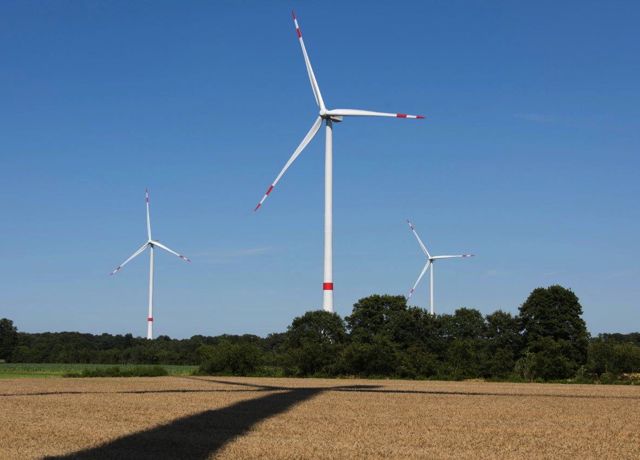
Germany has awarded just over 1800MW of tenders for onshore wind farms in the country’s latest renewables tender.
A total of 2.5GW of bids were submitted across 135 applications, with 129 receiving contracts covering 1836MW.
The value of the awarded bids is between 7.25 euros cents per kWh and the maximum permitted value of 7.35 cents per kWh.
At 7.34 cents per kWh, the average, volume-weighted surcharge value is only slightly below the maximum value.
The largest award volumes were for bids for locations in North Rhine-Westphalia (32 awards covering 379MW if capacity), Lower Saxony (17 awards for 319MW), Mecklenburg-Western Pomerania (16 awards for 274MW) and Brandenburg (14 awards for 244MW).
The Federal Network Agency published the tender awards, noting that 2023 saw a record volume of bids, reaching 6500MW.
In the years 2018 to 2022, no more than 3700MW were offered in any year, and in 2018 and 2019 even less than 3000MW were offered in each year.
“The encouraging trend continues. Tenders for onshore wind continue to increase. When it comes to wind, we are not yet where we want to be in order to achieve our expansion goals. But we are on the right track here,” said Klaus Müller, President of the Federal Network Agency.
“In the tenders for solar roof systems, the amount of bids has even increased slightly.”
Managing Director of VDMA Power Systems Dr. Dennis Rendschmidt said: “It is good and important that more and more projects for onshore wind turbines are starting now. However, this pace still needs to be increased. The prerequisite for this is that more permits are issued for the construction of new plants in the future – and that these projects are actually implemented. This is the only way to reduce the current gap in construction.
“But the signing also shows that further measures are necessary. To ensure smooth processes, the federal and state governments must continue to reduce bureaucratic obstacles, administrative hurdles and unnecessary recurring inspections of the systems as quickly as possible and ensure uniform framework conditions nationwide.
“In addition, for the efficient transport of large-scale and heavy-duty transport of wind turbine components to the construction sites, it is necessary to create uniform national requirements to simplify and streamline the approval process.”