


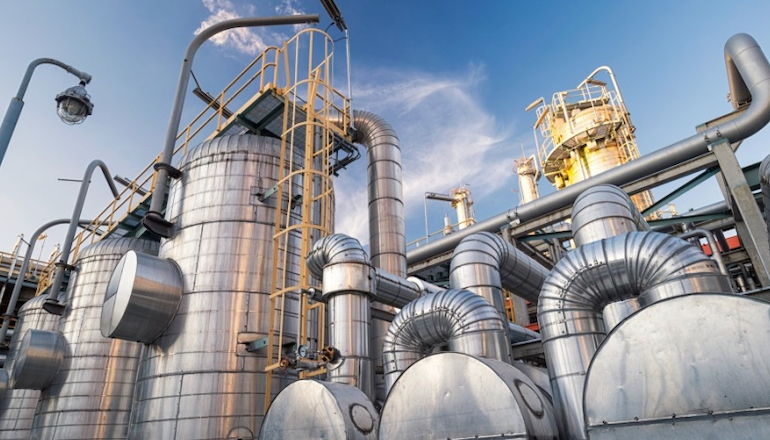
Adoption of green hydrogen technology will play a crucial role in enabling the global chemicals industry to decarbonise, which today accounts for 4% of global greenhouse gas (GHG) emissions.
A new report, by Systemiq and the Center for Global Commons at the University of Tokyo, has warned that without urgent action, the chemicals industry faces “reputational and regulatory risk and may lose its social license to operate”.
The industry’s supply-side transition requires a shift away from fossil fuels and feedstocks, enabled by green hydrogen, as well as scaling of carbon capture and storage (CCS) to capture residual emission from production processes and end of life chemicals.
The Planet Positive Chemicals report predicts that replacing fossil feedstocks will make the chemicals industry the largest global consumer of green hydrogen (up to half of all demand by 2050) and will “drive scale-up of this critical enabler of the energy transition”.
This creates economic opportunities as the site of primary chemical production for developing countries that have abundant, affordable renewable energy sources to make low-cost green hydrogen.
The report identifies several opportunities for green hydrogen to enable emissions reduction in the global chemicals industry, including through switching to renewable feedstocks and through switching to non-fossil fuel energy sources.
The report highlighted that by 2050, as much as 82% of carbon feedstock can come from alternative sources, an 89% reduction from today.
In addition, up to 234 Mt per year of green hydrogen may also be required, predominantly (99%) as feedstock for ammonia and methanol to enable use of alternative carbon feedstocks for chemical production.
Using renewable energy rather than fossil fuel to produce heat can avoid process emissions.
Up to 12,000 terawatt-hours of renewable energy capacity will be required in a net zero system, although this is predominantly needed to produce green hydrogen feedstock.
Of the remainder, 4% is used for electric steam crackers and other production processes, 3% is used for carbon capture, and less than 1% is used to make green hydrogen for steam cracker heat.
Ammonia production is the largest contributor to Scope 1 and 2 emissions by the basic chemical intermediates industry today.
Continued growth in fertiliser, such as for decarbonising shipping, mean it would experience a surge in demand from 185 Mt in 2020 to more than 1000 Mt by 2050, of which three-quarters is new net zero applications.
This would be the largest demand growth of any basic chemical intermediate by 2050, representing as much as 32% of the 500 Mt per year of projected global green hydrogen demand in a net zero economy by 2050, highlighted the report.
“This is why transforming both existing and new production capacity to renewable (non-fossil) energy and feedstocks is critical to enable a sustainable future,” it stated.
Planet Positive Chemicals estimates that achieving net zero Scope 1-3 emissions by the global chemicals industry will require around $100bn a year in capex deployment between 2020-2050, 2.7x larger than capital requirements for business as usual growth of the system.
The report stated: “Firstly, adequate large-scale capital must be allocated for deployment into the system transition.
“Secondly, a network of financial intermediaries, infrastructure, products and expertise to deploy the capital must be developed.
“Thirdly, a pipeline of high-quality joint venture transformation projects are needed to create a clear track record for mainstreaming circular and low-emissions technologies.
“Achieving this will require government policy support as well as shifting perceptions of value, business models, technology risk, rates of return, and capex profiles across the chemical value chain.”