

Close Menu
reNEWSreNEWS
  • Home
  • Offshore Wind
  • Onshore Wind
  • Solar
  • Other News
    • Energy Storage
    • Finance
    • Grid
    • People
    • reMIX
  • More
    • Company Profiles
    • Events
    • National Wind Energy Awards 2026
Latest News

PODCAST: Is UK offshore wind back on track?

All-Energy 2026: Shanks bullish on UK clean power

GWEC, TÜREB launch wind partnership

LinkedIn Facebook X (Twitter)
  • Email Briefings
  • About
  • Advertise
  • Contact
reNEWSreNEWS
  • Home
  • Offshore Wind

    PODCAST: Is UK offshore wind back on track?

    May 13, 2026

    UK offshore wind pipeline reaches 93GW

    May 13, 2026

    Seaway7 completes Hai Long cable works

    May 13, 2026

    DEME names new jack-up vessel

    May 13, 2026

    Mubadala invests $325m into Hornsea 3

    May 13, 2026
  • Onshore Wind

    ENERCON to build Türkiye blade plant

    May 13, 2026

    ‘Fatality at South Korean wind farm’

    May 13, 2026

    Scottish onshore wind forum launches

    May 12, 2026

    ENOVA starts 30MW Hiddels repowering

    May 12, 2026

    Iberdrola buys 40MW Italian wind farm

    May 12, 2026
  • Solar

    VSB secures Sicily PV project approval

    May 13, 2026

    Matrix connects two Spanish renewable projects

    May 13, 2026

    Qualitas targets €10bn energy investments

    May 12, 2026

    Consultation opens for 49.9MW Barrons Solar

    May 12, 2026

    Great North Road solar nears decision

    May 11, 2026
  • Other News
    • Energy Storage
    • Finance
    • Grid
    • People
    • reMIX
  • More
    • Company Profiles
    • Events
    • National Wind Energy Awards 2026
LinkedIn Facebook X (Twitter)
reNEWSreNEWS
Home » Uncategorized » Co-location of renewables leads to ‘significant cost savings’
Other News

Co-location of renewables leads to ‘significant cost savings’

Eleanore RobinsonBy Eleanore RobinsonDecember 7, 20224 Mins Read
Danish clean energy groups discuss merger

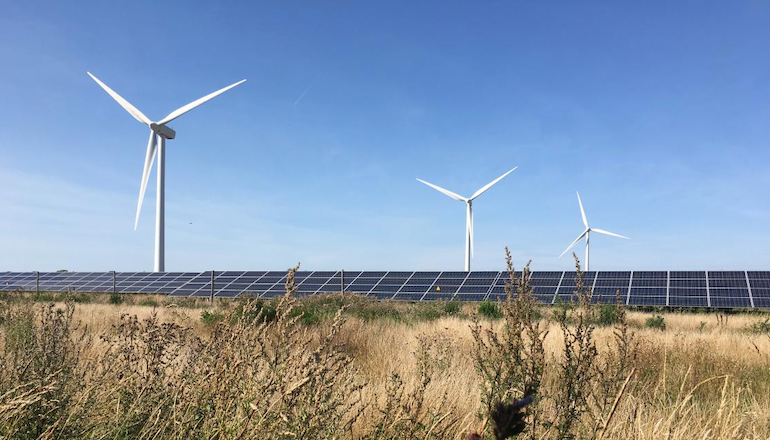
Using one grid connection for multiple renewable generation or storage assets could result in significant cost savings, according to a new report from Cornwall Insight and law firm Weightmans. 

Co-location, co-location, co-location outlines how co-location could incentivise the development of battery storage and the expansion of a variety of energy sources including solar and wind power, as well as low-carbon hydrogen production.

Advertisement

It could also help to accommodate new energy needs such as an increase in electric vehicle charging.

Setting up a new site, especially for storage assets, is currently a long and often costly process, involving planning permission, leasing costs and establishing a grid connection, the report states.

By co-locating a new renewable generation or storage asset behind an existing grid connection, developers will be able to both expedite and bring down the costs of developing the UK’s renewable generation capacity, it found. 

Furthermore, savings can be made by reducing capital and operational costs through using existing infrastructure and land that would otherwise be under-utilised and by taking advantage of spare grid connection capacity.

There is also the potential to co-locate the energy generation site with the demand site of a business, which could see savings by cutting the cost of importing the energy, the report concludes.

It adds that, while cost savings are a primary gain of co-locating, an additional related benefit to adding a new asset to an existing one is quicker connection to the grid.

With some storage assets facing a wait for a grid connection beyond 2030, co-location will speed up getting these online, which in a global energy supply crisis has never been more important, the report argues. 

Dr Matthew Chadwick, lead research analyst at Cornwall Insight said: “As the UK transitions to net zero, energy generation will become increasingly dominated by intermittent renewable generators.

“If we are to guarantee a consistent supply of energy, then more renewable generation and importantly increased energy storage will be essential.

“Despite this, concerns over planning permission, grid connectivity and leasing expenses are all putting up barriers.

“Through co-location of energy assets, we can utilise land that is already being used for renewables and storage, and use untapped grid capacity, cutting the cost and timeframe of expanding renewables – something desperately needed if we are to wean ourselves off unstable foreign energy imports.  

“As co-location expands there will be an increasing number of case studies for renewable generators and developers to turn to for best practice, and most importantly the pitfalls to avoid.

“This could see the ironing out of some challenges and complexities that may have put people off co-locating in the past.

“Ultimately, if the UK wants to stay on track with its net zero transition, and secure energy supply for decades to come, co-location will need to be an essential tool in the process.”

Nick Fothergill, partner at Weightmans said: “Co-location has been a trending topic within the industry for some time, but interest is accelerating as we see more sites come online, offering blueprints of best practice for the future.

“Combining different technologies through co-location can help grid efficiencies and unlock additional revenue streams, but also comes with added risks and complexities.

“It is time to think differently about how we approach co-location projects in order to maximise investment and make such schemes viable.

“There is no one size fits all approach, and flexibility is essential in order to generate the best outcome for all.

“Good legal advice can ensure that projects are de-risked and structured in a way that allows for developers to future-proof their projects and crucially, make funders more comfortable with their investment.

“As the focus on green and sustainable investment continues, co-location is expected to have a significant role to play, and we hope this report provides a useful analysis of the opportunities and challenges that lie ahead.”

Cornwall Insight Energy Storage Grid Onshore Wind Other News Solar
Share. Facebook LinkedIn Bluesky Twitter Reddit Email Copy Link
Previous ArticleUK ministers rule out new solar restrictions for England
Next Article EDF Renewables, Wärtsilä plan 50MW UK storage facility

Related News

GB among ‘top markets for battery hybrid schemes’

June 13, 2024

‘Renewables-battery projects cut power costs’

April 23, 2024

Law firm lauds ‘subsidy-free clean power future’

October 10, 2019
Advertisement

Latest News

PODCAST: Is UK offshore wind back on track?

May 13, 2026

All-Energy 2026: Shanks bullish on UK clean power

May 13, 2026

GWEC, TÜREB launch wind partnership

May 13, 2026

ENERCON to build Türkiye blade plant

May 13, 2026
Advertisement

Advertisement

Company Profiles
  • Collett & Sons Ltd
  • Leask Marine
  • Seaway7
    Seaway7
  • Qualsurv Marine Consulting
    Qualsurv Marine Consulting
  • Ørsted
  • Navantia Seanergies
    Navantia Seanergies
  • Natural Power
    Natural Power
  • Full Circle Wind Services
  • EEW
    EEW Special Pipe Constructions GmbH
  • EDF
    EDF
reNEWS
LinkedIn Facebook X (Twitter)
reMIX | Company Profiles | Industry Events
Get in touch | Advertising with us | About reNEWS

© 2026 Lewis Business Media. All Rights Reserved.
Lewis Business Media, Suite A, Arun House, Office Village, River Way, Uckfield, TN22 1SL

Terms and Conditions | Privacy Policy | Cookie Policy

Type above and press Enter to search. Press Esc to cancel.

Manage Consent
To provide the best experiences, we use technologies like cookies to store and/or access device information. Consenting to these technologies will allow us to process data such as browsing behaviour or unique IDs on this site. Not consenting or withdrawing consent, may adversely affect certain features and functions.
Functional Always active
The technical storage or access is strictly necessary for the legitimate purpose of enabling the use of a specific service explicitly requested by the subscriber or user, or for the sole purpose of carrying out the transmission of a communication over an electronic communications network.
Preferences
The technical storage or access is necessary for the legitimate purpose of storing preferences that are not requested by the subscriber or user.
Statistics
The technical storage or access that is used exclusively for statistical purposes. The technical storage or access that is used exclusively for anonymous statistical purposes. Without a subpoena, voluntary compliance on the part of your Internet Service Provider, or additional records from a third party, information stored or retrieved for this purpose alone cannot usually be used to identify you.
Marketing
The technical storage or access is required to create user profiles to send advertising, or to track the user on a website or across several websites for similar marketing purposes.
  • Manage options
  • Manage services
  • Manage {vendor_count} vendors
  • Read more about these purposes
View preferences
  • {title}
  • {title}
  • {title}