


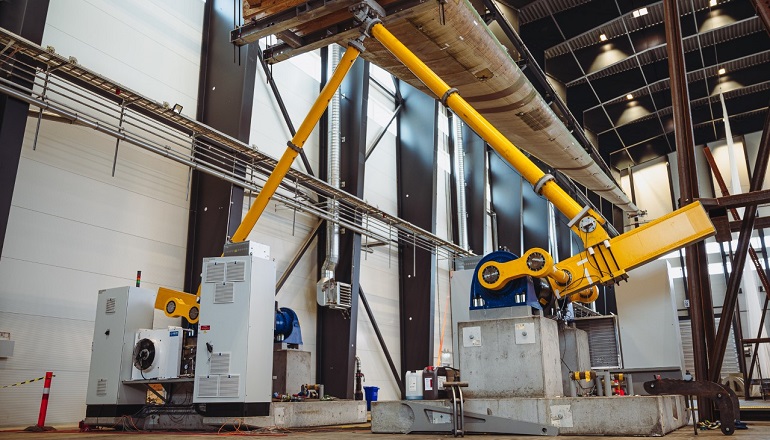
A consortium in Denmark has launched a project to develop a new test method and reduce time to market for next generation turbine blades.
DTU Wind (Technical University of Denmark) and a group of partners in Denmark are working on a new test method is “crucial in reducing time-to-market” for blades and the next generation of large offshore wind turbines.
The new test method is also expected to reduce unplanned blade repairs by an estimated 10% which is crucial in securing a stable wind turbine operation.
The new EUDP-funded project, BLATIGUE-2, is aiming to speed up the approval process of the blades by creating a “fast, smart method” to perform tests.
“We will develop new tools and software which the industry needs.
“When the tests of the blades are improved, fewer errors will occur, they will become more reliable, and this will also increase the wind energy’s competitiveness,” said project manager Kim Branner, from DTU Wind.
The BLATIGUE-2 project builds on the successful and earlier EUDP-funded project BLATIGUE, which developed the multi-axis fatigue blade test system, Dual Axis Exciter.
With the Dual Axis Exciter, OEMs can test their blades using only one test system, saving test time and changeover time when shifting between the test setups.
Even though the BLATIGUE project offers “unique fatigue testing possibilities”, it has also revealed some technical challenges and possibilities.
The BLATIGUE-2 project is developing new test simulation software, which will make it possible to achieve the full potential of the already existing technologies.
“This project will transform state-of-art technologies and make it possible for manufacturers to improve their blade design faster, cheaper, and more efficient,” says Rasmus Buch Andersen, technical product manager at R&D Test Systems.
The combination of the blade exciter and test software makes it less complex to execute the blade tests and provides a “significantly shorter” test time, reducing time to market for large offshore wind turbines.
The project is expected to be completed in 2025, though the project partners anticipate being able to present the first results from the project by the end of 2022.
The project partners are DTU Wind and Energy Systems, R&D Test Systems, LM Wind Power, Blade Test Center, Juel+Krøyer, Hottinger Brüel & Kjær, Zebicon, Siemens Industry Software, Det Norske Veritas, Danmark, Olsen Wings and Ørsted Wind Power.