


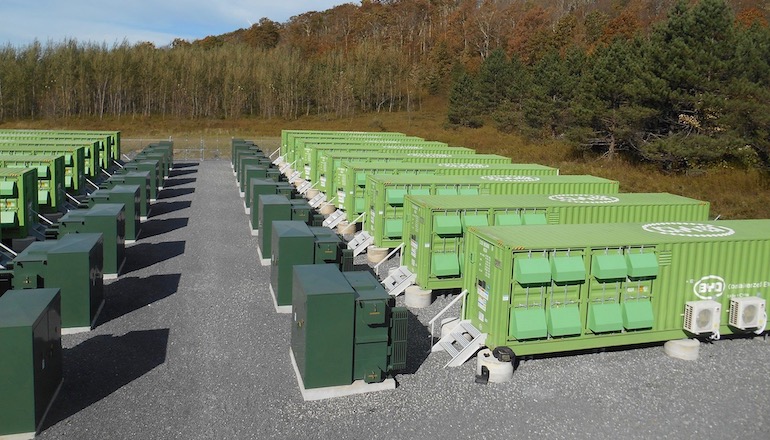
The global energy storage market will grow to 15GW in 2024 from 4GW last year, according to research by Wood Mackenzie.
Storage costs have fallen, direct incentives and clean energy targets are proliferating and competitive markets and vertically-integrated electricity providers are beginning to recognise the potential of energy storage, the analyst said.
Continued policy and regulatory efforts will be key to driving upside in the market, it added.
“The end of the decade will benefit from stabilising supply chains and mature and experienced players, however there will be even more potential for disruption from new technologies and policies,” Wood Mackenzie said.
Six areas will be key to the energy storage market, the company said.
They are offsetting corporate emissions, promoting economic potential, behind-the-meter (BTM) resiliency, accelerating the energy transition, reshaping the finance world and supply chain constraints.
Wood Mackenzie head of energy storage Daniel Finn-Foley said: “The energy storage industry is in the enviable position of juggling growth game changers from multiple directions.
“Plunging costs drove speculation in the first scaled markets but as price declines enter a steadier rate, further recognition of storage’s value – rather than cost – will be the key factor in determining growth.
“Oil major Total and automaker Opel announced a collaboration on electric vehicle (EV) cell manufacturing earlier this year, potentially investing as much as $5.5 billion in up to 47 GWh of manufacturing capacity.
“Total, already investing in stationary storage applications, and Opel clearly see batteries as a key element of the future.”
Companies like Microsoft, Google and Facebook have blazed a trail for scores of companies seeking to shrink or eliminate their carbon footprints, wood Mackenzie said.
Finn-Foley said: “When Google announced a partnership with NV Energy for significant solar-plus-storage investment to power data centres, they were not just breaking new ground in a key market but were pioneering a new way corporations value renewable energy.
“Rather than simply offset consumed electricity, Google seeks to time-match consumption with availability and that requires storage.
“If this catches on among other climate-forward corporations, the upside could be huge. Daimler’s commitment to procure renewables in real-time shows that this trend may become global.”
The European Commission launched a €10bn innovation fund last year targeting low-carbon technologies, including energy storage, while the US Department of Energy’s Energy Storage Grand Challenge represents the US federal government’s largest-scale action to date.
Innovation efforts have the potential to encourage alternatives to lithium-ion and potentially shift the market, said Wood Mackenzie.
Storage technology will be critical when renewable generation is not prolific, it added.
“Energy storage can play a role in balancing supply with demand on the electric grid and opportunities for BTM residential and non-residential energy storage are growing,” the company said.
Cost management has been a key driver for BTM applications globally, including in Australia, South Korea, Japan and the Philippines, it added.
Finn-Foley said: “Now, following the deadly and costly wildfires in California in recent years, regulators and policymakers are seeking every lever they can to mitigate risks to the public.
“One such lever is the Self-Generation Incentive Program, which will redirect 63% –
– or half a billion dollars – of its budget towards projects enhancing critical facility resiliency.”
Wood Mackenzie said that investment in the sector will be key.
Finn-Foley said: “Massive investment from international development entities, such as the World Bank and the Asian Development Fund, have already begun reshaping the relationship between finance and cleantech and this is quickly moving into the private sector.
“Blackrock expects a fundamental reshaping of finance and decided to end investment in thermal coal.
“The company also redesigned its investment strategy and put sustainability front and centre.
“Storage has emerged as a potential focal point for the focus on sustainability, with significant investment from a new multi-billion renewable energy fund set to flow into the storage space.”
However, development has not been without several hiccups, Wood Mackenzie said.
The past several years have been marked by delays caused by safety concerns, logistical problems that occur when transitioning from pilot to scale and uncertain market participation rules, the company said.
Finn-Foley said: “The supply chain question exists for any nascent industry but the energy storage market has the benefit and complication of overlapping supply chains with the EV and consumer electronics industries.
“Risks in the supply chain became evident late last decade as policies in South Korea drove deployments to that market, sucking the oxygen out of other international markets.
“Uncertainty goes even further up the chain, encouraging vendors to pursue alternative chemistries or push towards low-cobalt systems.
“Securing adequate supply to meet growing demand is an immense challenge and while vendors are scaling up with support from the energy and automotive industry, it is not immediately clear that supply can meet surging demand.
“Complications in key commodity availability, delays in manufacturing scale-ups and the gradually diverging priorities of the EV and stationary energy storage space could all throw sand in the gears, though there is significant potential for upside through second-life and battery recycling programs that will emerge over the next five-10 years.
“Stakeholders are already pulling, rather than being pushed, and turning to storage rather than being forced to consider it.
“The timing and speed of this push/pull shift and the speed with which the industry can react will define its potential.”