


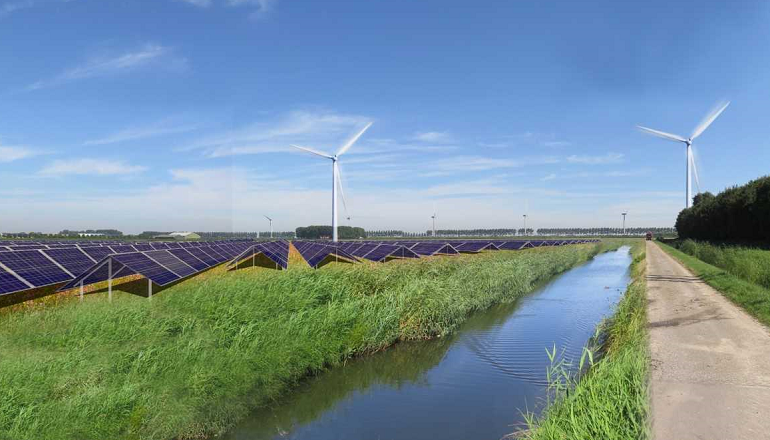
Vattenfall is developing its first wind-solar-battery power plant that will generate and store clean energy, in the Netherlands.
The developer has made the investment decision to build a photovoltaic system and a battery at its Haringvliet onshore wind project site, in the Goeree-Overflakkee region of South Holland.
Vattenfall will bring the whole plant online in the second half of 2020.
The Haringvliet Zuid full-hybrid power plant (pictured) will consist of six Nordex wind turbines with an installed capacity of 22MW, a 30-hectare ground mounted 38MW PV system, which is Vattenfall’s largest solar project to date, and a 12MW energy storage facility.
The BMW-made batteries will be housed in 12 shipping containers.
The investment in the solar and storage components of the project total €35m.
Vattenfall had already made the €26m investment decision for the Haringvliet wind project in November 2018.
Construction preparations are already underway.
The solar farm’s construction will begin once the wind turbines are installed and the battery containers will be installed last.
Hybrid power plants can produce a steady output, reducing the load on the grid and resulting in a more efficient use of network infrastructure.
Vattenfall solar and batteries business head Claus Wattendrup said: “In addition, the costs for grid connection are significantly reduced compared to standalone systems.
“This will reduce the cost of renewable electricity and ultimately benefit customers.”
The battery will enable the plant to provide network services and will help offset forecasting inaccuracies in generating weather-dependent renewable electricity.
He says the plant can provide lessons that can also can serve the energy transition in Germany.
“We believe that economies of scale that we are talking about in this context will have a very positive impact on the economics of such plants,” said Wattendrup, adding that from 2020, large-scale solar, wind and hybrid power plants could be realised in Germany without any support.
He says reuse of coal fields and mining areas offers potential for building such plants in future, referring to a recent report, called ‘Renewable Energy Projects in the Opencasting Regions’, which was commissioned by the Federal Ministry of Economics.