


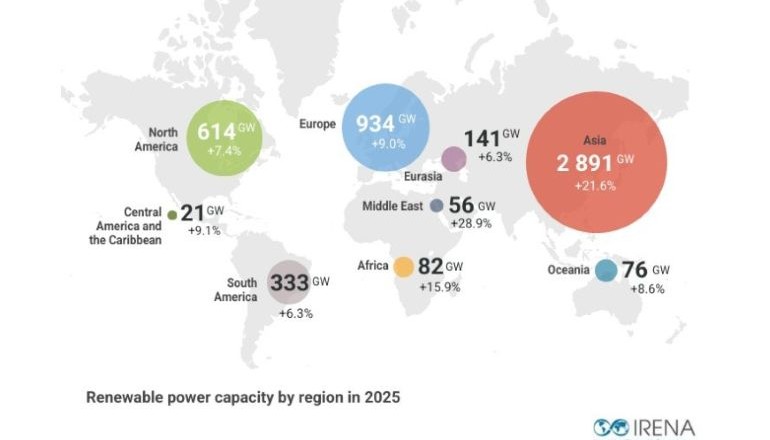
Global renewable energy additions hit a record 582GW in 2024 but the growth rate is lagging behind international targets to triple installed capacity by 2030, according to a new IRENA report.
The agency said a “staggering” 1122GW must be added each year during 2025-30 in order to meet the 11.2TW end-decade benchmark set at the COP28 summit in 2023, requiring an annual growth rate of 16.6%.
IRENA’s progress report recommends integrating renewables targets into national climate plans ahead of COP30 in Belém, Brazil this year.
It also advises scaling investment into renewables to at least $1.4tn per year in 2025-30, more than doubling the $624bn invested in 2024.
United Nations Secretary-General António Guterres said: “The clean energy revolution is unstoppable. Renewables are deployed faster and cheaper than fossil fuels – driving growth, jobs, and affordable power.
“But the window to keep the 1.5C limit within reach is rapidly closing. We must step up, scale up and speed up the just energy transition – for everyone, everywhere.”
IRENA director-general Francesco La Camera added: “The world has broken renewable capacity records, but records alone will not keep 1.5C alive.
“Renewables are not just the most cost-effective climate solution, they are the biggest economic opportunity of our time.
“This report shows the path: accelerate deployment, modernise grids, scale clean-tech and strengthen supply chains. Every dollar invested brings growth, jobs and energy security.
“As the custodian agency tracking progress toward the global renewables goal, we call for greater ambition. By raising targets, mobilising finance and deepening cooperation, major economies can lead the energy transition and make COP30 a milestone.”
Global Renewables Alliance chairman Ben Backwell added: “The private sector is driving the energy transition, providing three-quarters of global clean energy investment. Our industries, led by wind, solar and hydropower, are already delivering growth, jobs and security.
“What we need now are long-term government plans that match national ambitions; we need pipelines that deliver projects. Plans must deliver enabling action on grids and storage and help maximise the benefits of the energy transition.
“This report shows that the march to renewable energy abundance is underway – and it’s time for us to accelerate.”
Strategic investment in modernising and expanding electricity grids is the essential foundation for integrating new capacity and strengthening energy security, the report stated.
An estimated $670bn must be directed each year until 2030 towards grids, with further investment required to rapidly scale up energy storage solutions, facilitate renewable integration and safeguard grid stability.