


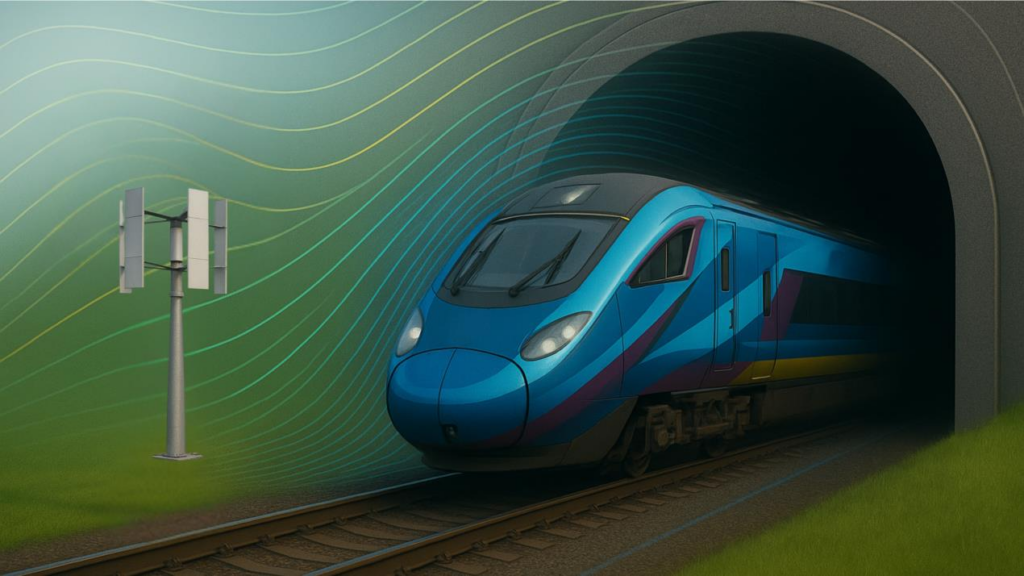
Researchers at the University of Manchester are developing innovative technology to turn wind flowing through railway tunnels into renewable energy.
The team from the Department of Mechanical and Aerospace are working with engineering consultant Q-Sustain to design the vertical axis wind turbines to capture the airflow generated by passing trains – known as the piston effect.
The university said that early feasibility studies have already confirmed the potential of tunnel airflow. Bespoke techno-economic analysis software known as VerXis has been developed to evaluate the performance and commercial viability of the turbine designs.
The next stage will be to test prototypes in actual tunnels as part of the project funded under the EPSRC Impact Acceleration Account to transform how transport infrastructure is designed and operated in future.
Dr Amir Keshmiri, academic lead of the project at the University of Manchester, said: “Our VerXis toolkit represents a leap forward in renewable energy research. By turning minimal tunnel geometry and schedule data into bank-level economic indicators in minutes, we’re bridging the gap between academic innovation and real-world deployment, making piston-wind VAWTs not just technically viable, but genuinely investable.”