


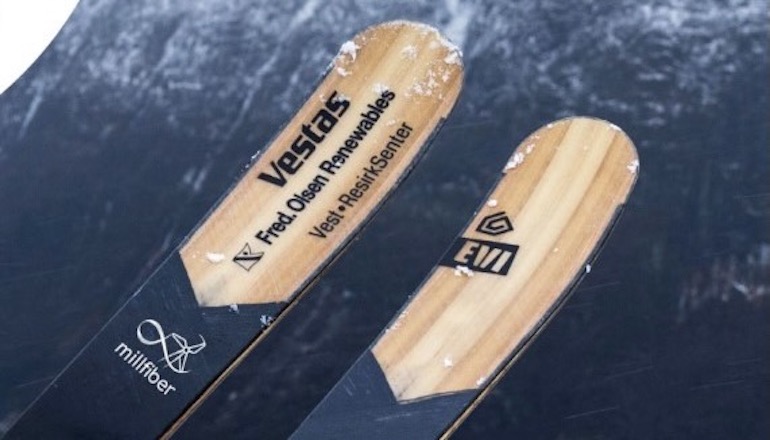
Turbine blades from Vattenfall’s Irene Vorrink wind farm in the Netherlands will be the first to enter the company’s recycling process and will be turned into skis, snowboards and construction materials for solar farms.
Vattenfall has set a target to recycle all dismantled turbine blades by 2030, and 50% of the blades already by 2025.
Recycling of the blades from Irene Vorrink is seen primarily as a pilot project, according to Vattenfall senior environment and sustainability specialist Gustav Frid.
He said: “First of all, we want to learn from this process and see which companies are suitable to help us recycle the wind blades.
“We believe that there is no single solution for this, but rather a number of different ones.
“Because Vattenfall has proven to be a leader in sustainability in recent years, many companies want to collaborate with us, and they are contacting us.”
Norwegian company Gjenkraft recovers glass and carbon fibres, depending on the type of blade.
Gjenkraft co-owner Marcin Rusin said: “We were looking for partners for our wind blade recycling project, came into contact with Vattenfall and since then we have been in constant contact with Gustav Frid about the progress of the work in our project.
“When the wind turbines of the Irene Vorrink wind farm were dismantled, we were one of the first to offer to recycle the wind blades.
“The blades consist not only of resin and glass or carbon fibre, but also of balsa wood, PVC or PET foam, other polymers and metals.
“It is almost impossible to separate the individual components, so they have to be processed together.
“This complicates the recycling process and the possibility of recovering residual value from the blades.
“In the recycling process, we can adjust the parameters to obtain the properties that our customers expect from our products.
“Our products are used again to make skis or snowboards and other products that contain glass fibres and carbon fibres.”
However wind turbine blades do not have to be completely dismantled to have a second life, according to MBO College Airport aircraft systems teacher Rene de Moor.
He said: “We want to offer our students an even broader field of knowledge and that’s how we came to wind turbines, because wind blades naturally have a lot to do with aircraft technology.
“We contacted Vattenfall and told them we wanted to train people for them. When asked what we needed for that, our answer was: knowledge, apprenticeships, and equipment.
“We had already bought a small nacelle simulator and we were still looking for other parts of the wind turbine.”
Before the MBO college got hold of two wind turbine blades from Irene Vorrink, they had to provide a good motivation, but that was no problem.
De Moor added: “One of the blades will be placed at MBO College Airport, where we will look specifically at the construction of the wind blade.
“How is it put together and how does it work exactly? The second wind blade will go to the Drone Engineering & Operations course in Valkenburg.
“They will use drones to inspect the wind blade. The drone can also attach itself to the blade and conduct minor repairs with a spay.”
Vattenfall’s Frid is excited about the different parties Vattenfall is now working with.
He said: “Both recycling and reuse play a key role in the development of sustainable industrial solutions.”