


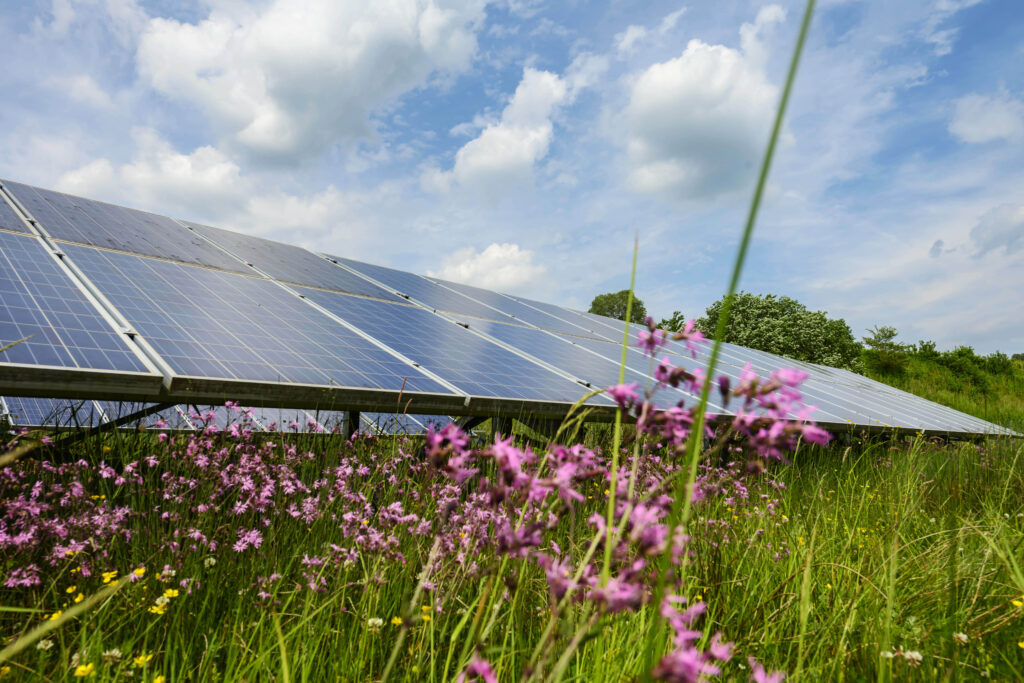
EnBW has held a groundbreaking ceremony for Baden-Württemberg’s largest solar park, an 80MW array south of Wilflingen in Langenenslingen, Germany.
Construction of the site began in February and, once complete, it will be capable of generating enough energy to supply around 30,000 households.
The site is set to enter into operation from mid-2025.
The ceremony was attended by a group representing local citizens, Biberach’s district administrator Mario Glaser and Langenenslingen’s mayor Andreas Schneider.
“With this solar park, we are putting Langenenslingen firmly on the map,” said Glaser.
“It is signalling that our region has a key role to play in the energy transition in Baden-Württemberg. Our region is showing how sustainable, local energy generation and community life are intertwined.”
Schneider added: “As a small district, we are actively shaping the energy transition here at local level, while at the same time strengthening our community, which will benefit from the revenues over the coming decades.
“We would also like to take this opportunity to thank the local council and the municipal council for their foresight and the unanimous decisions that led to this major project becoming a reality.”
Work on the land-use planning process and securing the site for the project was carried out by EnBW in close conjunction with the project developer SolNet GmbH.
The user contract for the site was signed in March 2020.
Thorsten Jörß, who is responsible for developing solar park projects at EnBW, said: “The fact that we are able to build our largest solar park in Baden-Württemberg here is also thanks to the owner of the land, Franz Freiherr Schenk von Stauffenberg.”
He has made around 80 hectares available for the solar park, an unusually large area for Baden-Württemberg. The building permit was secured in June 2023.
“Even a project as big as this can be realized swiftly if everyone pulls together as a team,” added Jörß.
All municipal and local council resolutions were passed unanimously.
Langenenslingen’s mayor Schneider worked especially hard to make sure that the necessary approval processes progressed quickly said EnBW. For example, the municipality convened round-table talks involving the district office, the municipality itself and EnBW in order to work through various points together in an efficient manner. Holding discussions in this format made it possible to answer questions swiftly, share information directly and take the necessary steps quickly.
Even before the official groundbreaking ceremony, EnBW had already begun preliminary construction work for the solar park. The substation used to feed the energy into the 110kV grid will be built in 2025. Commissioning and production of the first kilowatt-hours are planned for June 2025.
Once operational, the site is expected to cut carbon emissions by around 54,500 metric tons per year.
Various compensatory measures will preserve the existing habitats of the native animal species said the developer. To this end, landscape conservation measures were specified in the land-use planning process. Besides sowing seeds on the site, these measures include developing grassland for a large number of different species, planting a variety of shrubs, hedges and trees, and creating stepping stone biotopes.
The solar park will be built and operated without any funding under the Renewable Energies Act, added EnBW.