


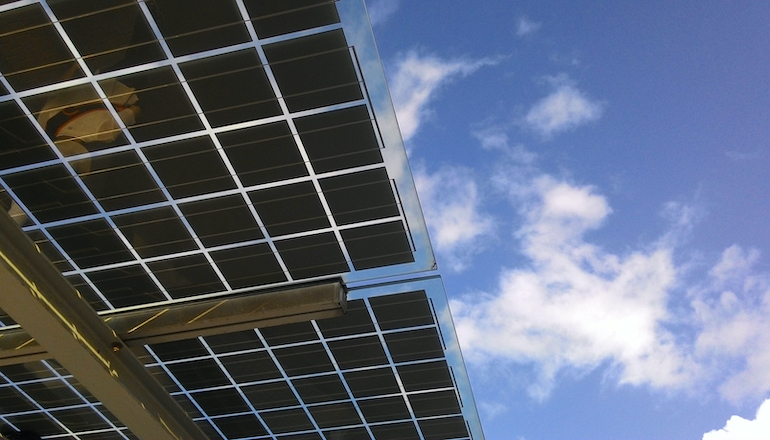
The mix of renewable energy sources (biomass, geothermal, hydropower, solar, wind) is now 30% of total US electrical generating capacity, according to new analysis.
Moreover, June was the tenth month in a row in which solar was the largest source of new capacity putting it on track to become the nation’s second-largest source of capacity – behind only natural gas – within three years.
The review by research organisation SUN DAY Campaign of mid-year data just released by the Federal Energy Regulatory Commission (FERC) reveals that 2192MW of solar was placed into service in June along with 34MW hydropower.
Combined they accounted for 98.9% of all new generating capacity added during the month.
Natural gas and oil provided the balance: 20MW and 5MW respectively.
During the first half of 2024, solar and wind added 13,072MW and 2,129MW respectively.
Combined with 212MW of hydropower and 3MW of biomass, renewables were 91.2% of capacity added.
The balance consisted of the 1100 Vogtle-4 nuclear reactor in Georgia plus 369MW of gas, 11MW of oil, and 3MW of “other.”
The new solar capacity added from January through June this year was more than double the solar capacity (6,446MW) added during the same period last year, according to the research.
Solar accounted for 77.4% of all new generation placed into service in the first half of 2024.
New wind capacity in the year to date accounted for most of the balance – 12.6% but that was slightly less than that added during the same time frame in 2023 (2761MW).
In June alone, solar comprised 97.4% of all new capacity added, followed by hydropower (1.5%).
Solar has now been the largest source of new generating capacity for ten months straight: September 2023 – June 2024.
For seven of those ten months, wind took second place.
Furthermore, FERC reports that net “high probability” additions of solar between July 2024 and June 2027 totals 88,526MW – an amount almost four times the forecast net “high probability” additions for wind (23,851MW), the second fastest growing resource.
FERC also foresees growth for hydropower (1240MW), geothermal (400MW), and biomass (90MW).
On the other hand, there is no new nuclear capacity in FERC’s three-year forecast while coal, natural gas, and oil are projected to contract by 20,542MW, 3,106MW, and 1,629MW respectively.