


The proposed Clean Industrial Deal will boost Europe’s energy security and industrial competitiveness while providing greater certainty for wind investments, Ditte Juul Jørgensen, Director-General for Energy at the European Commission, told delegates at WindEurope in Copenhagen.
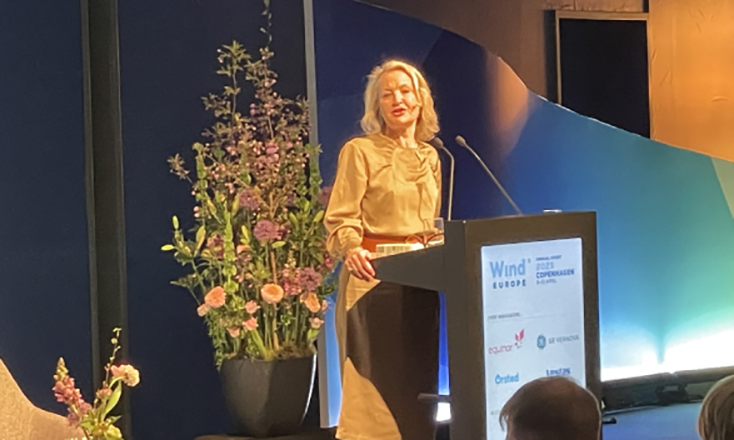
Jørgensen (pictured) said that the wide-ranging package that was unveiled by the European Commission in February would provide a “stable and predictable platform” for industrial growth that would “build on Europe’s existing strengths” in renewable energy.
“It is a significant work programme that we have ahead of us and there will be challenges, but there is a strong will and a commitment to work together … to achieve the goals, which are reducing energy costs, electrification, and to strengthen our security by reducing dependence on fossil fuel imports,” Jørgensen said.
She added that as well as a number of short term actions, such as measures to remove barriers to power purchase agreements, the Clean Industrial Deal would involve “fundamental changes” to reduce system costs and improve grid planning.
The Commission is working on drawing up an Electrification Plan to increase demand for clean energy, Jørgensen noted.
“The measures will ensure we are ready for the next energy crisis,” Jørgensen said. “But it is important that we deliver these measures on the ground.”
Jørgensen told delegates that a fundamental part of the Clean Industrial Deal will be a programme to boost supplies of clean energy by redoubling efforts to ensure Member States transpose new permitting rules to accelerate renewables uptake and grid investment.
There will also be measures to improve the flexibility of the energy system through investment in storage and other flexibility measures.
It will also build on earlier pledges made in the Wind Power Action Plan to improve the uptake of power purchase agreements to help reduce risks and “connect the dots” between renewables supply and industrial demand.
Jørgensen said that the Clean Industrial Deal would “create the conditions, the certainty, predictability, framework and regulations” for increased renewables investment. She added: “But for it to happen, (the wind sector) must develop the projects and the supply chains, and I hope it can be done.”